

A new dual-gated sensor architecture could give robots and prosthetics adjustable touch and proximity sensing while supporting denser, scalable electronic skin arrays.
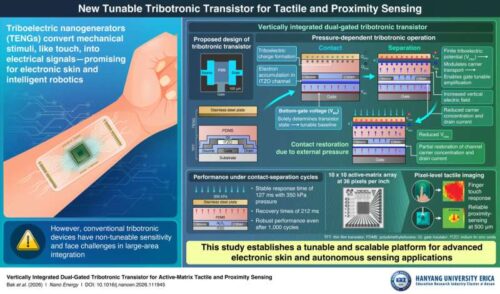
Hanyang University researchers have developed a vertically integrated, dual-gated tribotronic transistor that could form the basis of electronic skin for robots and prosthetic devices. The device combines a polydimethylsiloxane (PDMS) triboelectric sensing layer with an indium-tin-zinc-oxide (ITZO) thin-film transistor, allowing sensitivity to be adjusted electrically.
The architecture is designed to overcome limitations associated with conventional tribotronic devices, particularly fixed sensitivity and difficulties integrating sensors across large areas. The researchers say the stacked structure enables high-density integration while providing tunable amplification of triboelectric responses.
At the heart of the approach is a sensing mechanism that converts mechanical interaction into an electrical response. After the PDMS layer is charged through contact with a stainless-steel plate, separating the surfaces creates a triboelectric potential that affects current through the ITZO transistor. When the charged plate or another object approaches the surface, the potential changes and the transistor current recovers according to the object’s proximity.
A separate bottom-gate voltage establishes the baseline current and enables the sensitivity to be tuned. Tests using a transistor array demonstrated responses to finger touches and proximity sensing at distances of up to 500 micrometres.
The researchers believe the platform could support denser tactile sensor arrays for applications including healthcare robots, autonomous systems, prosthetics and wearable electronics. Its mechanically robust and programmable design is also intended to improve human-machine interaction by enabling machines to perceive touch, pressure and proximity more precisely.
The work, published in Nano Energy, presents a route towards scalable electronic skin while retaining flexibility in sensor sensitivity. The team describes the architecture as a potential platform for advanced tactile sensing, although further development will be needed before such systems can be integrated into larger practical applications.