




A compact LoRa communicator combines a built-in keyboard with long-range messaging and location sharing without depending on cellular coverage.
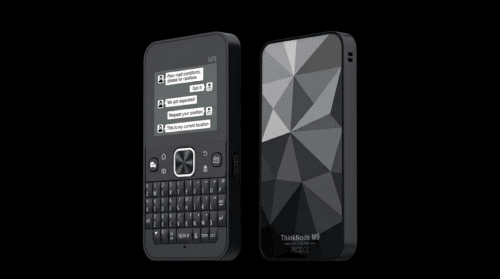
Elecrow has introduced the ThinkNode M9, a standalone long range (LoRa) communication terminal built around MeshCore firmware. It supports text messaging, location sharing and navigation over a LoRa-based mesh network without requiring cellular coverage or a connected smartphone.
The device combines an Espressif ESP32-S3R8 SoC with a Semtech LR1110 LoRa transceiver. Radio variants are available for the 868MHz European and 915MHz US bands. The ESP32-S3 also provides Wi-Fi 4 and Bluetooth Low Energy 5.0 connectivity. A 2.4-inch, 320 × 240-pixel TFT display and 37-key QWERTY keyboard provide the main user interface, while an integrated GNSS receiver supports GLONASS, Galileo and BeiDou for positioning. A magnetic compass adds directional information. Power comes from a 2,300mAh lithium-polymer battery, which Elecrow rates for two to three days of standby operation.
Unlike Elecrow’s earlier ThinkNode M1 and M2 devices, which use Meshtastic and depend on a Bluetooth-connected phone for typing messages, the M9 can be operated on its own. Its physical keyboard allows messages to be composed directly on the terminal, removing the need to carry a smartphone for basic communication.
The M9 joins a growing range of standalone LoRa messaging devices, including the LILYGO T-Deck family. Elecrow lists outdoor activities, emergency communication, remote fieldwork, scientific applications and offline community messaging among the intended uses. The device also arrives alongside products such as Makerfabs’ Nomad Terminal, which takes a different approach with a touchscreen interface and LR1121 LoRa transceiver.
MeshCore comes pre-installed on the ThinkNode M9, according to Elecrow. Support for the device has also been added to the official MeshCore web flasher. However, a dedicated public hardware repository or wiki for the M9 was not available at the time of writing. Since the board uses an ESP32-S3, developers can also work with the hardware using C, C++ or MicroPython through environments such as ESP-IDF and Arduino.
Elecrow lists the ThinkNode M9 at $74.90, with 868MHz and 915MHz versions available. The correct variant depends on the radio-frequency regulations in the country where the device will be used.
For more information, click here.


