

A new robot model learns physical tasks from seconds-long demonstrations, achieving high success rates without extensive task-specific training, optimisation or repeated human instruction over time.
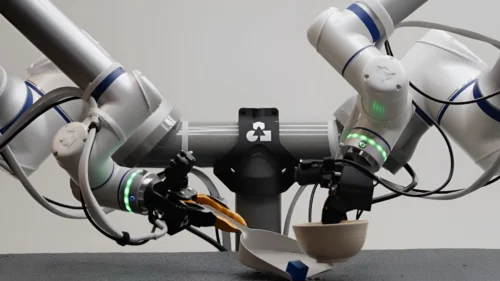
Generalist AI has developed GEN-1.5, a robot model designed to learn physical tasks from demonstrations lasting just three to 12 seconds. The approach could reduce the data and training time required to teach robots practical skills.
GEN-1.5 combines information from sensors, language and proprioceptive data to interpret demonstrations and generate action trajectories in real time. Rather than relying on extensive task-specific datasets and repeated optimisation, the system treats a demonstration as a physical prompt.
Tests across 10 physical tasks produced an average success rate of 94% when the robot received one demonstration. With five minutes of task-specific data and no gradient steps, its average success rate increased to 98%.
The demonstrations were deliberately simple and short. Tasks included twisting the lid off a glass jar, retrieving money from a purse, stacking cups, opening a book, emptying a pencil pouch and removing a vacuum pen.
The demonstration can come from a person using handheld grippers or from the robot itself performing the task. Once an example is provided, the model attempts to reproduce the behaviour without a conventional training phase.
GEN-1.5 can also combine separate physical prompts. In one demonstration, it received individual examples of emptying a pencil pouch and retrieving money, then connected the behaviours into a sequence. It generated intermediate repositioning and recovery movements that were not present in either demonstration.
The model also showed signs of generalisation beyond the exact actions demonstrated. A simulated demonstration could be used to prompt a real robot, while learned behaviour could adapt to different hands, objects and positions.
The work points towards a more flexible approach to robot learning, where brief demonstrations can provide enough information for machines to perform unfamiliar physical tasks without lengthy training processes.