

A new ground robot architecture combines wheeled, off-road, and legged mobility, aiming to simplify deployment across logistics, inspection, transport, and difficult terrain in one system.
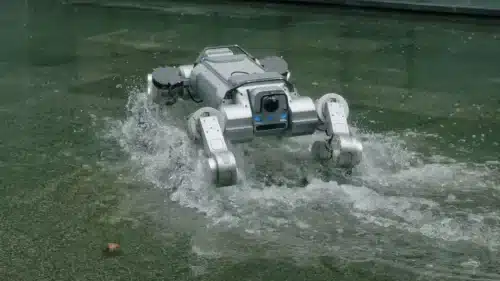
Galileo Robotics has unveiled Galileo X, a new ground mobility platform designed to combine the capabilities of wheeled robots, off-road vehicles, and legged machines within a unified architecture. The approach aims to help organisations handle indoor transport, outdoor travel, and complex terrain without relying on separate robotic platforms.
Unveiled at the 2026 World Robot Conference in Beijing, Galileo X is built around the company’s Unified Embodied Ground Mobility System. The architecture brings together hardware, actuation, perception, and motion control, addressing the fragmented designs traditionally used for different types of ground robots.
Conventional wheeled automated guided vehicles (AGVs) can provide precise indoor movement but are limited when surfaces become uneven. Off-road platforms offer longer-distance mobility, while legged robots can negotiate obstacles and difficult terrain. Galileo’s approach seeks to combine these capabilities through a common hardware architecture and unified control framework.
The platform is intended for a range of applications, including heavy-duty off-road handling, warehouse logistics, directional transport, inspection, perception and mobile operations. It can also serve as a mobile chassis for humanoid robots, potentially allowing different robotic applications to use the same underlying mobility platform.

Galileo says the integrated approach could reduce the number of specialised machines required across different operating environments. By coordinating multiple mobility capabilities through one system, organisations could also simplify deployment, maintenance and multi-device operation.
The company has developed its core hardware and underlying technologies in-house, including components and motion-control capabilities. Galileo also plans to open hardware and software interfaces around the platform, enabling algorithm developers, application providers and industry partners to build additional solutions.
The development highlights a broader shift towards flexible ground robots that can adapt their mobility to changing environments rather than remaining tied to a single form factor or operating scenario.