

A non-flammable electrolyte enables lithium-metal cells to exceed 500 watt-hours per kilogram without catching fire under abuse tests.
Researchers at Jilin University, working with the University of Science and Technology of China and several partner centres, have reported a lithium-metal battery electrolyte designed to combine high energy density with improved safety. According to the team, ampere-hour pouch cells using the electrolyte achieved a specific energy above 500 watt-hours per kilogram (Wh/kg), measured using the total mass of the complete pouch cell rather than the electrode stack alone.
Lithium-metal anodes have long been considered a potential successor to graphite because of their much higher theoretical capacity. The challenge has been developing electrolytes that can support stable lithium-metal cycling while also addressing the flammability and safety concerns associated with conventional liquid electrolytes.
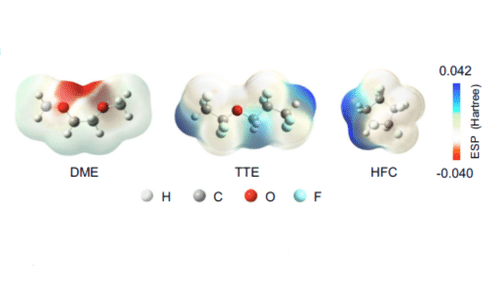
The design centres on what the authors call isolated solvation nanoclusters. The electrolyte uses a non-coordinating, non-flammable cyclic fluorinated diluent. Because this diluent does not coordinate with lithium ions, the lithium salt and coordinating solvent form separate nanoscale solvation clusters rather than a continuous solvation structure. According to the researchers, this microstructure improves lithium-ion transport through the electrolyte, helps suppress dendrite growth and promotes the formation of a stable solid electrolyte interphase (SEI) on the lithium-metal anode. These effects are important because uncontrolled dendrite growth can cause internal short circuits, while an unstable SEI can continuously consume electrolyte and lithium during cycling.
The reported cells retained 80 per cent of their capacity after 800 cycles and maintained more than 95 per cent capacity after eight months of calendar ageing. Calendar ageing is particularly relevant for electric vehicles, which spend much of their operating life parked rather than continuously cycling. The team also subjected fully charged cells to nail-penetration and 200 per cent overcharge tests. According to the researchers, neither test resulted in fire or swelling, although these results come from laboratory-scale cells and testing conditions rather than a commercially validated battery pack.
The reported energy density is well above that of many current commercial lithium-ion cells, although direct comparisons depend on the exact cell design and chemistry. Commercial nickel-manganese-cobalt (NMC) cells can reach roughly 250 to 300 watt-hours per kilogram at cell level, while lithium iron phosphate (LFP) cells generally offer lower specific energy but are widely used where cost, cycle life and safety are prioritised. A pouch cell exceeding 500 watt-hours per kilogram could therefore substantially increase vehicle range for a given battery mass or reduce the battery mass required for a given range.
The safety comparison is equally important. Conventional lithium-ion batteries commonly use flammable organic liquid electrolytes, and severe abuse conditions can trigger thermal runaway, potentially leading to fire. Battery fires involving electric two-wheelers in India prompted the government to strengthen safety requirements for traction batteries, including additional provisions covering cell behaviour, battery-management systems and thermal propagation. The Jilin University results are therefore notable, although they remain laboratory-scale cell results rather than evidence of safety performance in a complete commercial battery pack.
This is still a laboratory demonstration, although reaching an ampere-hour pouch-cell format is a meaningful step beyond the smaller coin cells commonly used in electrolyte research. It is not, however, a pilot-line or commercial manufacturing demonstration. Questions including the cost of the fluorinated diluent at scale, its performance across the wide ambient temperatures encountered in India, and the availability of a reliable supply chain remain outside the scope of the reported work. Fluorinated chemicals are also receiving increasing regulatory attention in Europe under broader restrictions and proposals concerning per- and polyfluoroalkyl substances, which could become relevant depending on the specific chemistry and classification of the materials used.
India strengthened its electric-vehicle battery safety framework following the 2022 electric two-wheeler fires, with amendments to AIS-156 for L-category vehicles and AIS-038 for larger vehicle categories adding requirements covering battery cells, battery-management systems, thermal propagation and other safety measures. The exact testing requirements depend on the applicable vehicle and battery standard, so the laboratory nail-penetration result should not be presented as a direct demonstration of compliance with an Indian vehicle-level regulation. Nevertheless, an electrolyte that improves cell-level resistance to severe abuse could eventually reduce the dependence on additional thermal barriers and other protective measures at the pack level, although that would need to be demonstrated in complete battery systems.
India’s National Programme on Advanced Chemistry Cell Battery Storage is intended to expand domestic cell manufacturing and increase local value addition, making electrolyte and other cell-material technologies relevant to the country’s developing battery ecosystem. However, translating this laboratory electrolyte into an Indian-made commercial cell would still require work on large-scale formulation, raw-material supply, manufacturing compatibility and qualification. Research groups across Indian institutions are also investigating advanced battery chemistries, including lithium-metal and solid-state systems, providing a growing domestic research base for such technologies.
Nothing in this result puts a 500 Wh/kg battery cell in an Indian showroom this decade. What it does show is a possible way to narrow the long-standing trade-off between energy density and safety. For a country working to expand domestic battery manufacturing while still relying heavily on imported cells and materials, a chemistry that could offer both higher energy density and improved resistance to fire is worth watching closely.
For more information, click here.