

A compact USB-C password vault stores encrypted credentials locally and enters them as keyboard input, offering an alternative to cloud-based password managers for users seeking greater control over their login data.
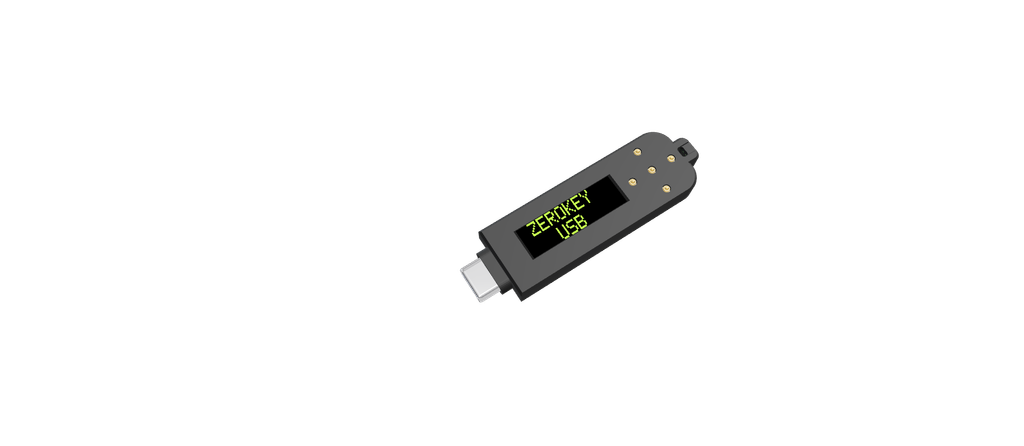
ZeroKeyUSB is a portable, hardware-based password manager that stores credentials offline and enters them directly into login fields through a USB keyboard interface. Developed by Depbit, the device is designed for users who need password access across multiple systems without installing software or relying on cloud services.
The device uses a Microchip SAMD21E18A microcontroller, an ATECC608A secure element and an M24C64 EEPROM to manage and protect stored credentials. Passwords are encrypted using AES-128 before being written to memory, while the secure element supports cryptographic key protection. The device can store up to 61 credentials according to its official technical specifications.
The key features are:
- ARM Cortex-M0+ processor operating at 48 MHz
- ATECC608A secure element with a hardware random-number generator
- AES-128 CBC encryption with random initialisation vectors
- ECDSA P-256 firmware signature verification
- Compact enclosure measuring approximately 60 × 15 × 5 mm and weighing 6 g
Unlike software-based password managers, ZeroKeyUSB presents itself to a connected host as a USB human interface device (HID), similar to a standard keyboard. After connecting it through USB-C, users unlock the vault with a PIN, navigate their stored entries and select the required credential. The device then types the login information into the active application or login form.
A built-in 128 × 32-pixel OLED display provides an interface for browsing credentials, while five capacitive touch pads enable navigation without a separate application. USB-C supplies operating power, eliminating the need for an internal battery, charging or battery replacement.
The device is intended for environments where software installation is restricted or internet connectivity is undesirable. Potential applications include IT maintenance across multiple computers, industrial workstations, laboratory systems, shared computers and field-service equipment. It can also be used with compatible smartphones and tablets that accept USB keyboard input.
ZeroKeyUSB’s firmware, schematics and hardware design files are available under the MIT open-source licence, allowing developers to inspect and modify the implementation. An accompanying offline web tool supports credential management and encrypted backups.
By keeping credentials on a physical device rather than synchronising them through a cloud account, ZeroKeyUSB offers an alternative for users prioritising local data control. However, it does not currently provide native two-factor authentication or FIDO-based login authentication.
Click here for the original announcement.