




What if developers could build smart rings, wristbands and patches without being locked into a closed wearable system? An open hardware and software platform offers flexibility for custom designs.
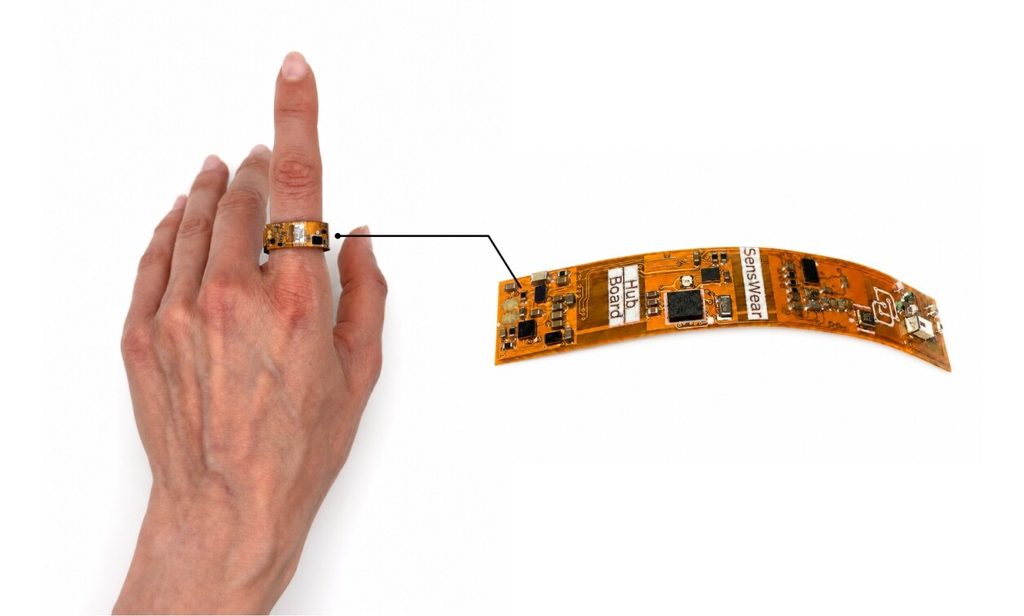
Sensera Technologies has introduced SensWear, an open-source development platform for smart rings, wristbands, patches and other wearable devices. The platform combines sensor hardware, Bluetooth Low Energy (BLE) connectivity and software development tools to help engineers build custom wearable applications.
SensWear is built around Nordic Semiconductor’s nRF54L15 BLE system-on-chip (SoC), paired with a Bosch BHI360 smart inertial measurement unit (IMU). It integrates battery charging and fuel-gauging circuitry, programmable LED control and an I²C-based expansion interface for interchangeable daughter boards.
The platform provides access to raw sensor data streams over Bluetooth, allowing developers to implement their own signal processing, data collection and edge artificial intelligence (AI) applications. This approach gives engineers greater control over how sensor data is processed, without depending on a closed wearable application programming interface (API).
The software stack includes Zephyr-based embedded firmware, Android and iOS applications, and Python and TypeScript software development kits (SDKs). Hardware designs, firmware and software are released under the MIT open-source licence, allowing developers to adapt the platform for their projects.
Its modular architecture also supports different wearable form factors using a shared core design. Engineers can develop additional daughter boards to integrate custom sensors and actuators, potentially reducing the effort required to create multiple device variants.
Available modules include the MAX30101 for multi-wavelength photoplethysmography (PPG) sensing, the MAX30208 for skin-temperature measurement, the MTCH6102 for 15-channel capacitive touch sensing and the DRV2605L for programmable haptic feedback.
Click here for the following announcement.
