HomeElectronics NewsOptical Transceivers Help Find Network Faults Remotely

Optical Transceivers Help Find Network Faults Remotely

Optical transceivers monitor fibre links, detect faults, collect network data, and support remote firmware updates in AI data centres.
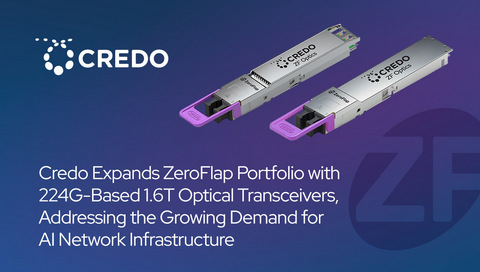
Credo's new ZeroFlap (ZF) optical transceivers combine the company's 224G per lane optical DSP with its Kfir200 silicon photonics-based photonic integrated circuit (SiPho PIC) and latest generation PILOT diagnostic and analytics platform. The launch marks a significant milestone in Credo's optical transceiver roadmap, extending the company's proven ZeroFlap reliability architecture to 1.6T port speeds. Credo's ZF transceivers enable operators to rapidly detect, diagnose, and mitigate fiber issues and link flaps before they impact AI workloads.
Credo’s new ZeroFlap (ZF) optical transceivers combine the company’s 224G per lane optical DSP with its Kfir200 silicon photonics-based photonic integrated circuit (SiPho PIC) and latest-generation PILOT diagnostic and analytics platform. The launch marks a significant milestone in Credo’s optical transceiver roadmap, extending the company’s proven ZeroFlap reliability architecture to 1.6T port speeds. Credo’s ZF transceivers enable operators to rapidly detect, diagnose, and mitigate fibre issues and link flaps before they impact AI workloads.

Credo Technology Group Holding Ltd has expanded its optical connectivity platform to 1.6T port speeds with its 224G-based ZeroFlap (ZF) optical transceivers. Designed for artificial intelligence (AI) data centre networks, the transceivers combine a 224G-per-lane optical digital signal processor (DSP), Kfir200 silicon photonics-based photonic integrated circuit (SiPho PIC), and PILOT diagnostic and analytics platform to monitor optical links and identify fibre issues before they affect AI workloads.

The 1.6T family supports 2xDR4, 2xFR4, and DR8 configurations for different AI scale-out network architectures. These are the first products in Credo’s portfolio to combine its DSP with its SiPho PIC. The design integrates the electrical and photonic parts to reduce insertion loss and improve link margin.

The ZeroFlap DSP includes Open Compute Project (OCP)-standardised telemetry features for monitoring power efficiency and signal integrity on individual ports in high-density AI clusters. The ZeroFlap architecture was previously used in Credo’s 800G Active Electrical Cable (AEC) and optical platforms.

The transceivers can work with Credo’s PILOT platform for optical-link monitoring, real-time telemetry, and fibre-problem and link-flap detection. PILOT telemetry extensions run on network switches and support Software for Open Networking in the Cloud (SONiC) and other switch operating systems. This allows optical-link data to be integrated into data centre monitoring and management systems.

Bidirectional remote telemetry allows network operators to collect link-health information from both ends of an optical connection without physical access to the remote side. This can help teams investigate faults and resolve intermittent link problems.

Remote firmware updates allow operators to update devices at the remote end with new features, performance changes, and security patches. Non-volatile event logging stores historical link-performance information for investigating intermittent failures and tracking network health over time.

The family supports AI data centre network topologies, including configurations that use fibre shuffle. It is available with Integrated Heat Sink (IHS) and Riding Heat Sink (RHS) options for switch-side and server-side installations.

The transceivers are intended for teams deploying and maintaining AI data centre networks that need high-speed optical links with link monitoring. They can be used to monitor optical-link health, identify fibre problems, investigate link failures remotely, update firmware, and maintain network performance as AI clusters scale.

Click here for the original announcement.

Loading form…
Nidhi Agarwal
Nidhi Agarwal
Nidhi Agarwal is a Senior Technology Journalist at Electronics For You, specialising in embedded systems, development boards, and IoT cloud solutions. With a Master’s degree in Signal Processing, she combines strong technical knowledge with hands-on industry experience to deliver clear, insightful, and application-focused content. Nidhi began her career in engineering roles, working as a Product Engineer at Makerdemy, where she gained practical exposure to IoT systems, development platforms, and real-world implementation challenges. She has also worked as an IoT intern and robotics developer, building a solid foundation in hardware-software integration and emerging technologies. Before transitioning fully into technology journalism, she spent several years in academia as an Assistant Professor and Lecturer, teaching electronics and related subjects. This background reflects in her writing, which is structured, easy to understand, and highly educational for both students and professionals. At Electronics For You, Nidhi covers a wide range of topics including embedded development, cloud-connected devices, and next-generation electronics platforms. Her work focuses on simplifying complex technologies while maintaining technical accuracy, helping engineers, developers, and learners stay updated in a rapidly evolving ecosystem.

SHARE YOUR THOUGHTS & COMMENTS

EFY Prime

Unique DIY Projects

Electronics News

Truly Innovative Electronics

Latest DIY Videos

Electronics Components

Electronics Jobs

Calculators For Electronics