
A single organic photodiode carries 3.6 gigabits per second over a one-metre light link, more than twenty times the previous organic Li-Fi record.
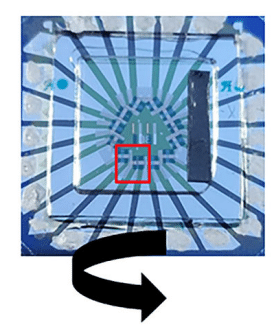
Researchers at the University of St Andrews and the University of Cambridge have developed organic photodiodes capable of gigabit-per-second visible light communication. The devices achieved a data rate of 3.6 gigabits per second (Gbps) over a one-metre link, demonstrating the potential of organic receivers for high-speed Li-Fi systems. The work was published on 9 September 2026 and was led by researchers from St Andrews’ Organic Semiconductor Centre and Cambridge’s Li-Fi Research and Development Centre, including Harald Haas, who coined the term Li-Fi.
Visible light communication (VLC) sends data by rapidly modulating a light source, with the receiver converting those changes in optical intensity into an electrical signal. Silicon photodiodes can detect these variations at high speed, but organic photodiodes offer advantages including mechanical flexibility, solution processing and potentially low-cost integration over large areas.
The main challenge for organic receivers has been bandwidth. Organic semiconductors generally have lower charge-carrier mobility, which limits how quickly photogenerated carriers can be collected. Thin-film device structures also introduce parasitic capacitance, creating an RC time constant that further restricts the response speed. The researchers addressed these limitations through targeted device engineering, enabling the photodiode to support a 3.6 Gbps VLC link.
The organic photodiode achieved 3.6 Gbps across a one-metre visible-light link using a single detector rather than an array. According to the researchers, this is more than twenty times the previous best VLC data rate demonstrated with an organic receiver, establishing a new performance benchmark for organic photodiodes in high-speed optical wireless communication.
Silicon photodiodes still have advantages in sensitivity, speed and temperature stability, while organic photodiodes offer a different set of benefits. They can be deposited from solution onto flexible substrates and potentially scaled to large-area devices. The 3.6 Gbps result narrows a longstanding speed disadvantage, although it does not yet make organic receivers a direct replacement for silicon across all applications.
Against radio, the advantage is mainly in spectrum reuse and spatial confinement rather than cost. Wi-Fi operates in shared 2.4 GHz and 5 GHz bands in India, where multiple devices compete for the same radio spectrum. Visible light remains largely confined to the illuminated space, allowing optical links to be reused across rooms with less cross-room interference. VLC also avoids the use of radio-frequency spectrum, although complete products must still comply with applicable electrical, optical and communications regulations.
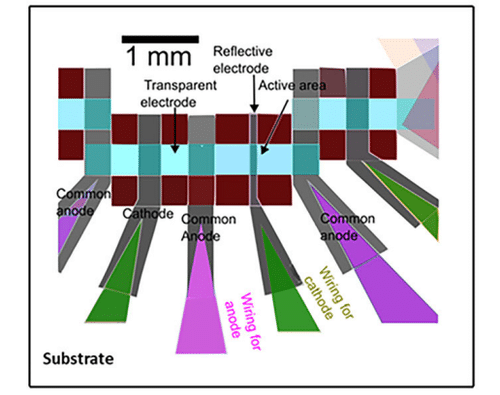
This remains a laboratory demonstration over a one-metre optical link rather than a finished communication product. The researchers describe the result as a new performance level for organic receivers and a step towards high-speed, flexible optical wireless systems. Moving from the bench to practical deployments will require further work on factors such as ambient-light rejection, receiver alignment, optical link budget and reliable operation over longer indoor distances. The result therefore demonstrates the receiver’s speed potential, but not yet the performance of a complete Li-Fi system in a real environment.
India already has an established research base for this technology. IIIT Delhi operates a Centre of Excellence on LiFi focused on visible light communication and optical wireless systems. Li-Fi has particular relevance in indoor environments where radio links may be congested or undesirable, including hospitals, aircraft and industrial facilities. Flexible organic receivers could expand the design options in such applications by allowing large-area detectors to be integrated onto surfaces rather than used only as discrete components.
Because the optical link does not use radio-frequency spectrum, the VLC portion itself does not require WPC spectrum authorisation. However, any complete product incorporating radio interfaces would remain subject to applicable WPC requirements, while BIS certification or registration would depend on the product category and relevant Indian standards. For engineering colleges, the practical route remains simpler: a conventional silicon photodiode, LED driver and signal generator can still provide an accessible bench platform for experimenting with VLC before moving to newer organic receiver technologies.
India is also preparing for 6G while demand for shared spectrum continues to grow. An optical layer that could eventually be fabricated on flexible, low-cost substrates is therefore worth watching as a complement to radio links in dense indoor environments, particularly where spectrum reuse and spatial confinement matter.
For more information, click here.