




A new paper-based design tool creates self-folding wearable sensors that conform to body shapes, offering a simple route towards flexible biosignal monitoring for personalised sensing.
Researchers at Shibaura Institute of Technology in Japan have developed a parametric design tool that transforms flat sheets of paper into self-folding helical wearable sensors. The approach integrates copper tape electrodes and automatically adapts sensor shapes to body dimensions, potentially simplifying wearable biosignal monitoring.
Led by Hiroki Shigemune, an associate professor at the institute’s college of engineering, the team developed the method with Yugo Takashima to address the challenge of creating wearable devices that fit curved body parts. Instead of manually shaping sensors or relying on straps and adhesives, the system generates patterns designed to fold into three-dimensional structures.
The design concept was inspired by climbing vines, which naturally wrap around supports in a helical form and adapt to their surroundings. By combining this principle with paper self-folding technology, the researchers can convert the dimensions of a finger, wrist, or arm into a practical two-dimensional pattern.
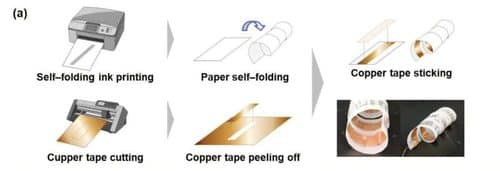
The fabrication process begins by printing self-folding patterns onto a flat sheet of paper using a specialised ink printer. The printed patterns cause the paper to bend and twist automatically along predefined crease lines. As individual tabs gradually deform, the flat sheet forms a 3D helical structure that conforms to the wearer’s body while retaining flexibility for movement.
Copper tape electrodes are integrated into the resulting structure, allowing the sensors to measure biosignals without requiring conventional straps or adhesives. The design tool can therefore generate customised wearable structures according to the dimensions of the targeted body part.
The research could make personalised wearable sensors easier to design and fabricate by reducing manual construction. The paper-based approach also offers a lightweight route for creating flexible devices that closely follow the body’s shape.
By combining parametric design, self-folding fabrication and integrated electrodes, the work points towards wearable electronics that can be customised for different users and body locations. The approach could support future biosignal-monitoring devices where flexibility, lightweight construction and comfortable fitting are important.


