




Can a police robot pursue a suspect across streets, rough terrain, and water? A self-balancing sphere is being tested with sensing and non-lethal systems.
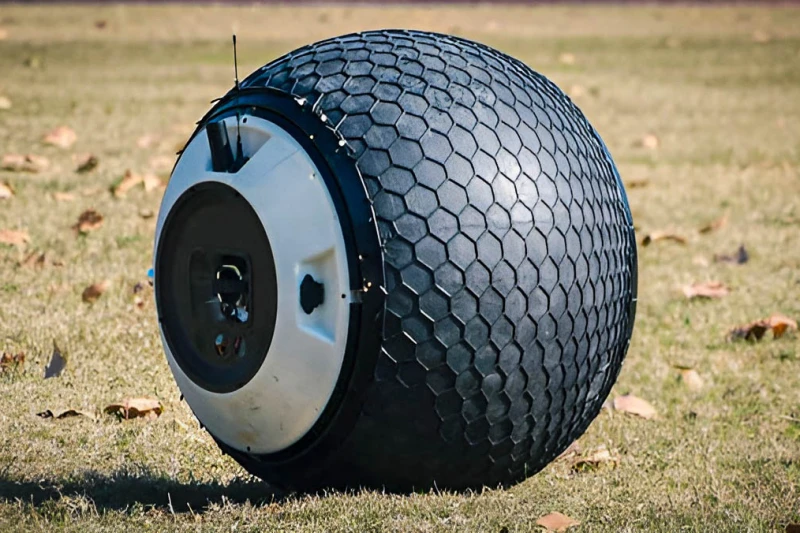
Chinese police have begun trialling a spherical amphibious robot designed for patrol, pursuit, and suspect apprehension. Developed by Logon Technology, the Rotunbot RT-G was deployed with police patrols in a commercial area of Wenzhou, Zhejiang province, in December 2024.
Unlike conventional wheeled or tracked patrol robots, the RT-G uses a spherical body with an internal motion and stabilisation system. Motors shift an internal mass to control the robot’s movement and maintain balance, allowing the outer shell itself to roll across the ground. The design also allows the platform to operate in water, giving it an advantage in environments where a conventional ground robot could be restricted.
The 125-kg robot has a reported top speed of 35 km/h and is designed to handle mud, slush and light off-road terrain. Its sensing package includes GPS, cameras, and ultrasonic sensors for positioning, environmental awareness, obstacle avoidance, and target tracking. Its spherical construction is also designed to withstand significant impacts.
For the police trials, the platform has been equipped with non-lethal systems including net launchers, tear gas, smoke devices, horns, and acoustic crowd-dispersal equipment. These allow the robot to support officers in situations where approaching a suspect directly could expose personnel to risk.
The RT-G has been presented as an autonomous platform capable of identifying and tracking targets, but reports from the initial police deployment indicate that the units were being operated remotely. This makes the current trial as much a test of the robot’s mobility and police integration as of its autonomous capabilities.
The spherical design also opens applications beyond policing. The platform has been associated with operations in difficult or hazardous environments, including rescue and inspection, where an enclosed amphibious robot could travel through terrain that limits conventional mobile platforms. The Wenzhou deployment provides a real-world test of whether that mobility can translate into useful patrol and pursuit capability.


