




What if an EV battery could reveal how much useful life remains without being opened? A student has found a way to estimate it.
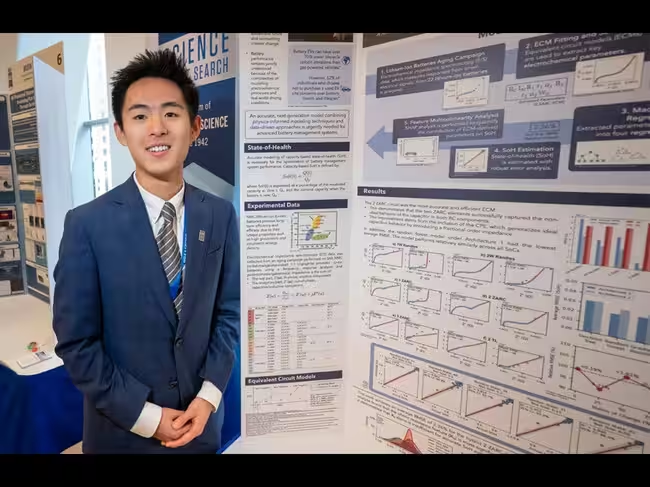
Colin Jie Chu, an 18-year-old student at The Nueva School in California, has developed a model to estimate the health of ageing lithium-ion EV batteries. The framework combines battery physics with machine learning and reportedly achieved a prediction error of 2.36%.
The work addresses a challenge in electric mobility: determining how much useful capacity remains in a battery after repeated charging, discharging, temperature changes, and varying operating conditions. Battery management systems cannot directly inspect internal degradation, so battery health must instead be inferred from electrical behaviour.
Chu analysed data from 22 batteries that were deliberately aged using electrical signals designed to replicate changing driving conditions. He then combined an equivalent circuit model, which represents battery behaviour through mathematical electrical components, with machine-learning regression.
The physics-based model provides a representation of how the battery behaves, while machine learning helps interpret patterns in the measured data. This combination is intended to estimate state of health under changing operating conditions rather than relying entirely on either conventional modelling or data-driven methods.
More accurate health estimation could help battery management systems make better decisions around charging, maintenance, remaining useful life, reuse, and eventual recycling. It could also help operators identify degradation before it significantly affects vehicle performance.
The research was conducted through Stanford University’s Young Investigators Program at Professor Simona Onori’s Stanford Energy Control Lab, with involvement from researchers and industry partners. Chu began the project in 2024 and later presented the work at the Modeling, Estimation, and Control Conference in Chicago.
The study was also published in the Journal of The Electrochemical Society. The reported 2.36% error was achieved on research data, meaning further testing across battery chemistries, vehicle platforms, ages, and real-world driving conditions would be required before wider deployment.


