

Researchers have developed biocompatible quantum sensors that measure temperature and free radicals inside living cancer cells, offering new ways to study cancer biology more precisely.
Researchers from Japan’s National Institutes for Quantum Science and Technology (QST) and the University of Tokyo have developed Molecular Quantum Nanosensors (MoQNs) that can measure temperature and detect free radicals inside living cancer cells. The research could provide a new electronic sensing approach for studying cellular processes associated with cancer.
The biocompatible sensors use pentacene molecular spin qubits embedded in organic nanocrystals. These quantum sensors are designed to perform absolute thermometry and free-radical detection within specific parts of living cells, including the nucleus and cytoplasm.
The researchers engineered the MoQNs to operate inside cancer cells and map radical-generation processes alongside thermal dynamics. These measurements could help researchers investigate cellular behaviour linked to cancer-associated physiology.
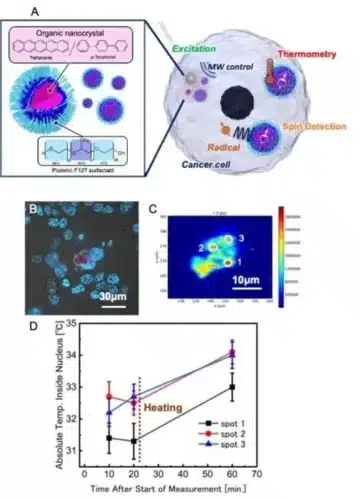
The sensors consist of photo-excited triplet electron spins from pentacene guests incorporated into para-terphenyl host nanocrystals. A Pluronic F127 surfactant shell encapsulates the nanocrystals, making them water-dispersible and allowing cellular uptake without toxic aggregation, according to the research.
Unlike conventional inorganic quantum sensors, including diamond nitrogen-vacancy centres, the MoQNs are synthesised using a bottom-up approach without introducing lattice vacancies. This provides structural reproducibility and reduces spectral variation between sensor batches.
The technology also demonstrated temperature measurements within individual cellular regions. Experimental results shown in the research indicate changes in intracellular temperature over the measurement period, allowing the researchers to observe thermal behaviour at a small spatial scale.
The work points towards quantum sensing as a potential tool for investigating biological processes with greater precision. By combining temperature measurement and free-radical detection within living cells, the sensors could provide researchers with additional information about how cancer-related cellular activity develops.
However, the reported work is primarily a research demonstration rather than a finished medical diagnostic system. Further development and validation would be required before the technology could be considered for practical clinical applications.