




Scientists have integrated insect olfactory receptors with graphene transistors, creating semiconductor sensors capable of detecting tiny chemical traces for healthcare, environmental monitoring and food safety.
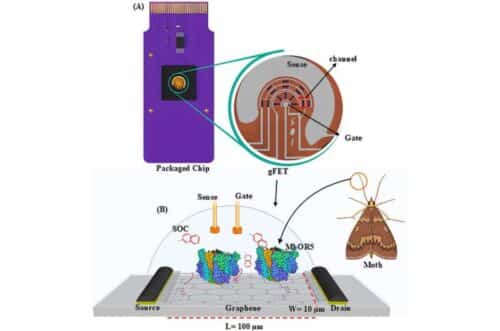
Researchers at the University of California San Diego have developed a semiconductor sensor that mimics an insect’s sense of smell by integrating an olfactory receptor from the Machilis hrabei insect onto graphene field-effect transistors (gFETs). The team says the breakthrough could pave the way for highly sensitive, label-free chemical detection across healthcare, environmental monitoring, agriculture and food quality testing.
The study demonstrates how biological sensing mechanisms can be combined with semiconductor technology to identify small organic compounds that are difficult for conventional electronic sensors to distinguish. By attaching the purified insect olfactory receptor, known as MhOR5, to graphene transistors, the researchers created a device capable of translating chemical interactions into measurable electrical signals.
The team evaluated the sensor using 16 different chemical compounds, including DEET, hexanol and eugenol, at varying concentrations. Each substance produced a distinct, concentration-dependent electrical response, showing the platform could reliably differentiate between multiple target molecules.
To manufacture the device, researchers synthesised the genetic sequence for the olfactory receptor, expressed it in mammalian cells and purified the resulting protein. They reported that the receptor remained stable after three months of storage at -80°C and continued to perform after repeated freeze-thaw cycles. The purified protein was then chemically bonded to the graphene surface using established crosslinking techniques.
According to the researchers, this marks the first direct integration of the MhOR5 receptor with a graphene field-effect transistor for selective detection of small organic compounds. They believe the work highlights how advances in biology, semiconductor engineering and biomanufacturing can be combined to produce scalable biosensors.
The findings, published in Advanced Materials, could support the development of compact electronic noses for medical diagnostics, pollution monitoring, industrial safety and agricultural applications, while providing a practical route towards manufacturing bio-inspired sensing systems at scale.
