What if robots did not need a fixed front or back? Engineers have proposed a different approach to robot design based on how evenly it can move through space.
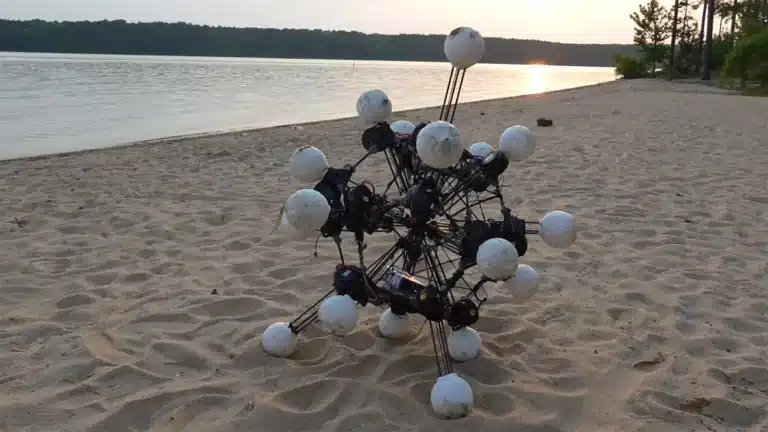
Duke University engineers have developed Argus, a 20-legged robot designed to demonstrate a new principle called dynamic isotropy. The approach shifts the focus from the physical symmetry of a robot to how uniformly it can accelerate and move in different directions.
The researchers simulated more than 1500 robot configurations to identify a design approaching the theoretical limit of dynamic isotropy. The resulting robot has no defined front or back, with 20 modular, telescoping legs extending from a central core.
Each leg carries a depth camera and is positioned at a vertex of a regular dodecahedron, providing a near-uniform distribution of both movement capability and field of view around the robot.
Dynamic isotropy assigns a score from 0 to 1 based on how uniformly a robot can accelerate its centre of mass in different directions. Argus achieved a score of 0.91, while most existing robots, including advanced quadrupeds, humanoids and conventional drones, score below 0.6, according to the researchers.
The team’s simulations indicate that increasing dynamic isotropy can improve several aspects of robotic performance, including trajectory tracking, energy efficiency, resilience to damage and operation across difficult terrain.
Argus demonstrated these capabilities in experiments on concrete, grass, forest trails, sand, wet surfaces and bark. It could roll over obstacles up to five inches high, recover after being pushed, continue moving after losing three legs, carry a 10-pound payload at nearly full speed and climb between parallel vertical walls.
The robot could also track and push a three-foot cube while continuously rolling, demonstrating that its whole-body actuation and perception can support movement without requiring a fixed orientation.
“Most robotics research has framed symmetry as a question about the body, but we argue that the more powerful symmetry is at the level of what the robot can do,” says Boyuan Chen, who leads the research and directs Duke’s General Robotics Lab.