




Researchers have developed a novel rotating metamaterial architecture that enables long-range wave interactions while reducing unwanted interference, opening new possibilities for sensors, medical ultrasound and vibration-control systems.
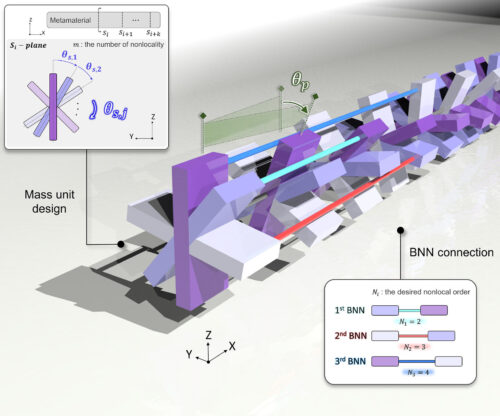
Researchers from Seoul National University, in collaboration with the Korea Research Institute of Standards and Science (KRISS), have developed an innovative elastic metamaterial platform that could significantly improve the control of waves and vibrations across a broad range of applications. The study introduces a new structural concept called Metaspire, designed to overcome key limitations of conventional nonlocal metamaterials.
Elastic metamaterials are engineered materials that manipulate the propagation of waves and vibrations. While existing designs can control wave transmission, they typically operate within a limited frequency range and often face interference issues when multiple long-range interactions are introduced. These challenges have restricted their use in more complex engineering systems.
To address these limitations, the research team designed a structure featuring rotating unit elements arranged in a sequential pattern. This configuration naturally creates space for long-range interaction pathways without adding significant structural complexity. As a result, the platform supports nonlocal interactions while suppressing unwanted wave effects that commonly occur in previous designs.
The researchers validated the concept through numerical simulations and experimental testing. Their results demonstrated that the proposed architecture enables precise control over wave transmission and suppression across a much broader frequency spectrum than conventional elastic metamaterials. The design is also scalable, allowing it to be extended from one-dimensional systems to more complex two- and three-dimensional structures.
According to the researchers, the Metaspire platform could serve as a foundation for next-generation technologies requiring advanced wave manipulation. Potential applications include vibration-reduction systems, high-performance sensors, ultrasonic imaging devices, medical ultrasound technologies and other precision engineering systems. The approach could also support future developments in smart sensing and communication hardware.
The team believes the research represents a significant step towards translating nonlocal metamaterial concepts from theoretical studies into practical engineering solutions. The findings, published in the journal Advanced Materials, provide a versatile design framework that may accelerate innovation in wave-based devices across multiple engineering disciplines.

