




Could future quantum computers compromise today’s encrypted data? A security platform aims to help engineers prepare hardware and infrastructure for evolving cryptographic standards.
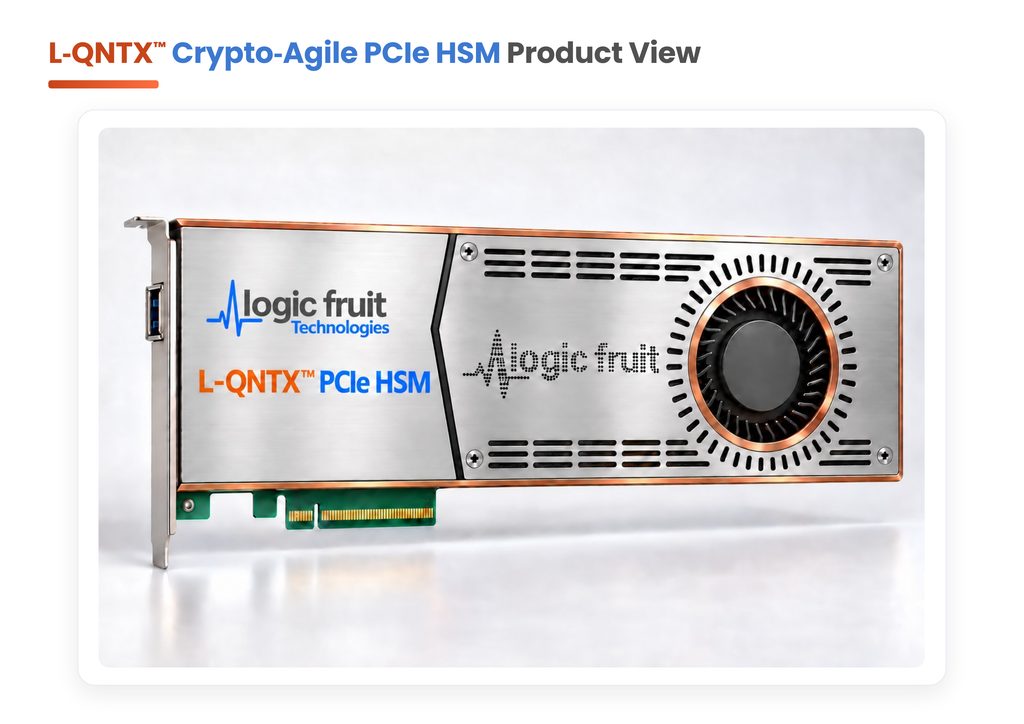
Logic Fruit Technologies has announced L-QNTX, a family of quantum-safe security products under development for semiconductor devices, embedded systems and enterprise infrastructure. The platform is designed to support post-quantum cryptography across silicon, hardware security modules (HSMs) and computing infrastructure.
The platform is planned to support established cryptographic algorithms, including RSA and elliptic-curve cryptography (ECC), alongside post-quantum algorithms standardised by the National Institute of Standards and Technology (NIST). These include ML-KEM for key encapsulation, ML-DSA for digital signatures and SLH-DSA for hash-based signatures. Supporting conventional and post-quantum methods within a crypto-agile architecture is intended to help systems adapt as security standards evolve.
The planned portfolio includes licensable cryptographic intellectual property (IP) for field-programmable gate arrays (FPGAs) and application-specific integrated circuits (ASICs), embedded hardware root of trust, PCIe security platforms and network-attached HSMs.
Planned capabilities include protected key storage, secure boot, authenticated firmware updates, cryptographic acceleration and policy enforcement. Integration with existing security infrastructure is intended through standards and interfaces such as PKCS#11, KMIP, Java Cryptography Extension (JCE) and REST APIs. The HSM architecture is designed to pursue FIPS 140-3 Level 3 validation; certification has not been confirmed.
The platform addresses concerns that sufficiently capable quantum computers could undermine widely used public-key cryptography. Information encrypted today could be retained for future decryption, a risk known as harvest now, decrypt later. Crypto-agility could help organisations introduce post-quantum algorithms while maintaining compatibility with existing systems.
Click here for the official announcement.
