




Seeed Studio’s RK3576 kit combines a Rockchip RK1820 accelerator for 26 TOPS of local AI performance at 379 dollars.
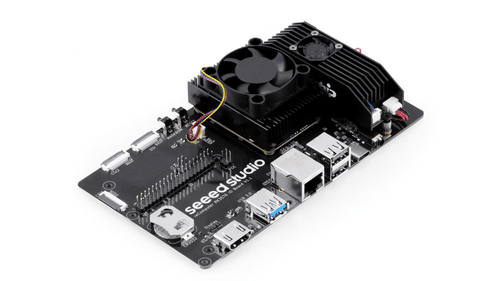
Seeed Studio has released a development kit that combines its reComputer RK3576 compute module with Rockchip’s RK1820 AI accelerator card. Together, the platform delivers up to 26 tera-operations per second (TOPS) of INT8 AI performance in a compact system intended for edge AI development and local inference.
The kit with the accelerator installed costs 379 dollars, while the base version without the RK1820 is priced at 219 dollars. The reComputer RK3576 compute module is also available separately, starting at 130 dollars.
The Rockchip RK3576 combines four Arm Cortex-A72 cores running at up to 2.2 GHz with four Cortex-A53 cores at up to 2.0 GHz. It also includes an Arm Mali-G52 MC3 GPU and a 6 TOPS INT8 neural processing unit (NPU). Seeed currently lists module configurations with 4 GB LPDDR5 and 32 GB eMMC or 8 GB LPDDR5 and 64 GB eMMC storage.
The wider RK3576 platform is specified with support for up to 16 GB LPDDR5 memory and 128 GB eMMC storage. Seeed also sells the separate I/O carrier board for 18 dollars.
The additional AI performance comes from the RK1820 accelerator, which contributes 20 TOPS of INT8 compute and includes 2.5 GB of onboard DRAM. The dedicated memory allows AI model data to remain close to the accelerator rather than relying entirely on transfers across the system bus.
Seeed lists support for models including DeepSeek-R1-Distill-Qwen 7B and Qwen2.5-VL 3B, a vision-language model. For computer vision workloads, the company quotes YOLO11 performance of up to 77.9 frames per second with 640 × 640 input images.
The development is significant because low-cost edge boards have traditionally focused on workloads such as image classification, object detection and sensor processing. Earlier Rockchip platforms with NPUs in the 6 TOPS range were well suited to these applications but offered less headroom for larger generative AI workloads.
The combined RK3576 and RK1820 platform pushes more generative AI capability into the lower-cost edge hardware category. Support for a 7B language model means developers can experiment with local inference without automatically requiring a workstation GPU or a cloud-based API.
This does not make the kit equivalent to a workstation-class AI system. A quantised 7B model running on a 26 TOPS edge platform will not deliver data-centre-level inference performance, and the suitability of the system will depend on factors such as model size, quantisation and latency requirements.
The kit provides one USB 3.0 Type-A port, two USB 2.0 Type-A ports and a USB Type-C port. Display connectivity includes HDMI, DisplayPort and a four-lane MIPI-DSI interface, while dual MIPI-CSI interfaces support camera connections.
Networking includes Gigabit Ethernet with Power over Ethernet powered-device support, Wi-Fi 6 and Bluetooth 5.4. Storage expansion is available through an M.2 M-key 2280 slot using PCIe 2.1 x1 and a microSD card slot. Armbian comes preinstalled, with support also listed for Debian, Ubuntu, Android 14 or later and balenaOS.
For Indian buyers, the final cost will be higher than the listed 379-dollar price once shipping and any applicable import charges are included. The precise landed price will depend on the product’s customs classification, taxes and shipping arrangements, making a direct rupee conversion potentially misleading.
The platform’s local inference capability could nevertheless be useful for applications where network connectivity, latency or data handling are important. Indian-language voice interfaces, industrial vision systems and other edge applications can benefit from processing data locally rather than continuously transmitting audio, images or sensor data to a remote cloud service.
For now, this is primarily a development platform rather than a replacement for high-performance AI workstations. But it shows how generative AI workloads are beginning to move onto increasingly affordable edge hardware, bringing local language-model experimentation within reach of smaller laboratories, developers and product teams.
For more information, click here.


