





Researchers created a recyclable, self-healing substrate that improves durability, strengthens conductor adhesion and enables component recovery, reducing electronic waste in flexible sensor applications.
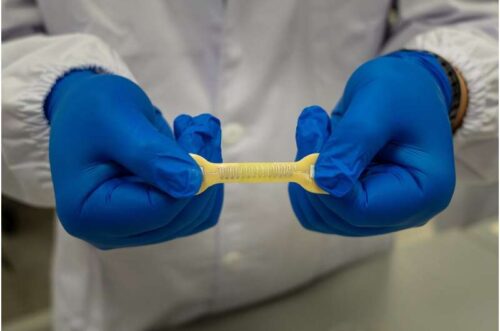
Researchers at the National University of Singapore (NUS) have developed an intrinsically dynamic biosubstrate (IDBS) that repairs itself, firmly bonds metal conductors and can be recycled at the end of a device’s life. Published in Nature Sustainability, the innovation aims to improve the durability of wearable sensors while reducing electronic waste through easier material recovery.
Designed for soft electronics such as wearable health patches and electronic skin, the substrate combines two naturally occurring compounds—lipoic acid and phytic acid—to form a molecular network without requiring catalysts or organic solvents. Three complementary chemical bonds enable the material to balance flexibility, strength and self-repair, while also improving adhesion to metal conductors.
Laboratory testing showed the material could stretch to more than eight times its original length before breaking. After severe damage, samples recovered more than 80 per cent of their strength within six hours and over 90 per cent within 24 hours. The repair efficiency remained above 90 per cent after five repeated damage-and-repair cycles, demonstrating long-term durability.
The researchers also addressed a common weakness in wearable electronics by improving the bond between the substrate and metal conductors. Heat-assisted processing increased adhesion to zinc circuits by around tenfold compared with room-temperature attachment. Silver coatings adhered three times more strongly than on conventional silicone substrates and continued producing reliable signals after 800 friction cycles against artificial skin.
Prototype electronic skin devices successfully monitored temperature, moisture, breathing, strain, heart activity and muscle signals while maintaining stable performance under repeated use. At the end of the device’s life, reheating softens the substrate so electronic components can be removed intact, while ethanol treatment breaks down the material to recover silver particles and reprocess the remaining residue as an adhesive.
Life-cycle assessments indicated the recyclable substrate could have a lower environmental impact than several conventional flexible electronic materials, offering a practical route towards more sustainable, repairable and reusable wearable electronics.

