

A battery-free artificial synapse combines tactile sensing, memory, and learning, enabling flexible wearable electronics to recognise human activities while operating without external power sources continuously.
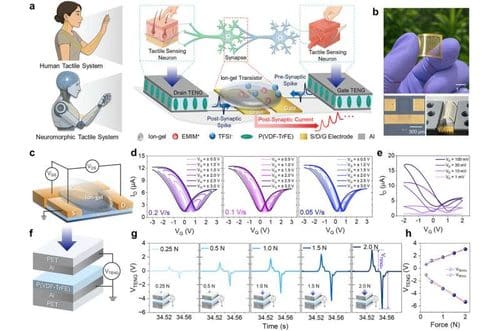
Dongguk University researchers have developed a self-powered flexible triboelectric-gated ion-gel transistor (g-IGT) that combines tactile sensing, memory, and neuromorphic learning without an external power supply. The device uses triboelectric nanogenerators (TENGs) to convert mechanical stimuli such as touch, movement, and vibration into electrical signals for wearable applications.
The technology addresses a limitation of graphene-channel ion-gel-gated transistors, which can operate flexibly at low voltage and reproduce synaptic behaviour but typically require an external power source. The researchers integrated two TENGs with a single g-IGT to create a battery-free neuromorphic system.
One TENG supplies presynaptic spikes through the transistor gate, while another provides postsynaptic signals through the drain. Mechanical stimulation therefore generates the electrical pulses required to control the artificial synapse. This allows sensing and synaptic processing to occur within the same flexible platform.
The device demonstrated several memory characteristics. Sensory memory showed a decay time of about 70ms, while short-term memory exhibited decay times between 0.2 and 0.45 seconds. Repeated stimulation could transition short-term responses towards long-term memory, with a decay time exceeding two seconds. The system also demonstrated spike-rate-dependent plasticity, with its behaviour remaining stable when the device was bent.

Researchers evaluated the measured synaptic behaviour using a single-layer artificial neural network for human-activity recognition. Using publicly available motion data, the system classified walking, sitting, standing, lying, stair climbing and stair descending with 88.05 per cent accuracy while the device was bent. Under high-noise conditions, accuracy remained above 75 per cent, although performance declined with severe signal distortion.
Potential applications include self-powered health-monitoring wearables, electronic skin, smart prosthetics, human-machine interfaces and intelligent motion-monitoring systems. The work, published in Advanced Materials, demonstrates a route towards flexible electronics integrating sensing, memory, learning and processing in a single platform.