




A sub-seven-dollar LED smartphone attachment sweeps light across a room and uses deep learning to identify concealed camera lenses among everyday objects.
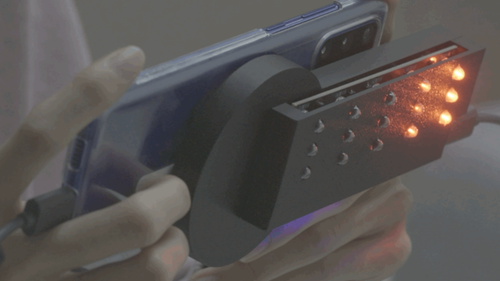
Researchers have developed a smartphone attachment that detects concealed cameras by analysing how their lenses reflect light. The work was carried out by researchers from Korea Advanced Institute of Science and Technology (KAIST’s) School of Computing in collaboration with the National University of Singapore and Singapore Management University. The hardware consists of a small light-emitting diode (LED) case that clips onto a smartphone and costs less than US$7.
The method uses an illumination sweep. The smartphone camera remains stationary while LEDs surrounding it illuminate the scene sequentially from different angles. Ordinary glossy surfaces respond predictably: a plastic bezel, glass panel or polished screw head produces a highlight that moves across the surface or disappears as the illumination angle changes.
A camera lens behaves differently. Its curved optical elements can reflect light back towards the camera, producing a characteristic glint whose behaviour depends on the lens geometry rather than the object concealing it. A deep-learning model analyses these changing reflection patterns and distinguishes concealed camera lenses from ordinary reflective objects.
The team reports around 94 per cent detection accuracy across 30 real-world objects, including chargers, clocks and remote controls. Each inspection takes less than five seconds, while the LED attachment itself costs less than US$7. According to the researchers, the low-cost design is intended to make concealed-camera detection accessible to non-experts rather than requiring specialised security equipment.
Consumer hidden-camera detectors generally fall into two categories, and both have known limitations. Infrared torch-and-filter devices rely on users spotting a reflected glint, which can be difficult in brightly lit environments and may produce false positives from ordinary reflective surfaces. Radio-frequency scanners instead search for wireless transmissions, meaning they can miss cameras recording directly to local storage and may also detect other radio signals in the area. SweepLED takes a different approach by detecting the camera lens itself, a component required for a conventional camera to capture images regardless of whether it is transmitting wirelessly or recording locally.
The paper, titled Hide-and-Sweep, was presented as a peer-reviewed research contribution at ACM MobiSys 2026. It remains a research prototype rather than a commercial product. The evaluation covered 30 objects, including 12 concealed-camera objects and 18 reflective non-camera objects, making it a limited experimental evaluation rather than a large-scale field trial across hotels or rented accommodation. The SweepLED hardware design files, firmware, smartphone application and training dataset have not been publicly released, according to the available KAIST and publication records.
Voyeurism using a concealed camera is addressed under Section 77 of the Bharatiya Nyaya Sanhita, alongside relevant provisions of the Information Technology Act, 2000. Hotel rooms, trial rooms and paying-guest accommodation continue to feature in reported cases involving concealed cameras. Consumer hidden-camera detectors available in India are primarily infrared lens finders or radio-frequency scanners, with retail prices ranging from a few hundred rupees for basic devices to several thousand rupees for multi-function detectors.
The hardware described here consists primarily of LEDs, associated driver electronics and a smartphone attachment, with the required components readily available through Indian electronics distributors. The optical rig is therefore relatively straightforward for an Indian electronics or computer science department to reproduce, although the deep-learning model and training data represent the more difficult part of the system. India already manufactures LED lighting at scale, making an approach based on LED illumination and a smartphone potentially closer to the domestic electronics supply chain than specialised imported detection equipment.
For more information, click here.


