




Smartphone batteries are crossing 10,000 mAh as silicon-carbon anodes pack more energy into the same space without relying entirely on conventional graphite.
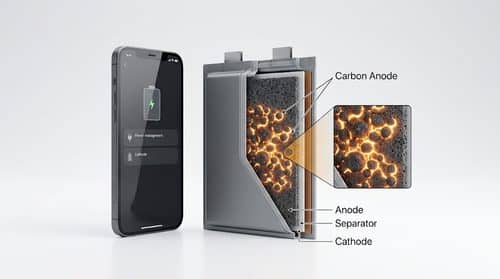
A 5000 mAh battery was once a major selling point for smartphones. In 2026, phones available in India are reaching 9000 mAh and even 10,001 mAh without becoming dramatically thicker. The change is not a new battery chemistry, but an evolution of the lithium-ion anode, where silicon is being added to the graphite used in conventional cells.
For users, higher-capacity batteries can mean longer periods between charges. The technology also helps explain why Chinese smartphone brands have pushed battery capacities higher, while Apple, Samsung and Google have been more conservative with battery sizes.
A conventional lithium-ion battery stores lithium in the anode during charging and releases it during discharge. Most anodes use graphite, which has a theoretical capacity of about 372 mAh/g. Silicon can theoretically store several times more lithium, with commonly cited values reaching around 4200 mAh/g.
However, silicon expands significantly when it absorbs lithium. This expansion can damage the electrode and cause rapid capacity loss over repeated charging cycles. Silicon-carbon anodes address the problem by distributing silicon within a carbon structure that provides mechanical support and space for expansion.
Well-designed silicon-carbon electrodes can therefore use more silicon without suffering the same level of mechanical damage. Smartphone manufacturers do not generally disclose the exact proportion of silicon used in their commercial cells.
Realme’s P4 Power 5G is one of the clearest examples of the trend in India. Its 10,001 mAh Titan Battery uses what the company calls a third-generation silicon-carbon anode. The phone weighs 219 g and supports 80W charging, with Realme claiming 50 per cent charge in 36 minutes.
Realme also claims the battery can complete 1650 full cycles before its capacity falls to 80 per cent, alongside an eight-year battery-health guarantee covering at least 80 per cent capacity.
The growth is visible beyond individual models. Industry tracking by 91mobiles found that smartphones with batteries of 6,000 mAh or more accounted for 10 per cent of global smartphone sales in January 2025, rising to 29 per cent in January 2026. Its testing also showed average battery runtime increasing from about 13 hours in 2024 to about 15.5 hours in 2026.
Silicon does not make a phone battery ten times larger. Compared with a graphite cell of similar dimensions, silicon-carbon technology typically provides a more modest increase in energy density. Gains of around 10–20 per cent can allow manufacturers to increase capacity without proportionally increasing battery size.
The largest 9000 mAh and 10,000 mAh batteries also gain capacity from changes in cell packaging and slightly larger or heavier phones. The technology comes with trade-offs, including higher cell costs and potential ageing challenges under aggressive charging conditions. This makes cycle-life guarantees increasingly relevant alongside headline capacity figures.
This is already shipping technology rather than a laboratory demonstration, but many long-term performance figures remain manufacturer claims. Real-world ageing data under India’s high temperatures is also more limited than laboratory cycle testing.
India is an important market for the big-battery trend. Many of the highest-capacity phones are aimed at value-conscious buyers, while most phones sold in India are assembled locally. However, the origin and technology of the cells themselves can differ by model and supplier.
As India develops domestic battery manufacturing, silicon-carbon anodes could become an important technology for increasing energy density in locally produced smartphone cells. For consumers, meanwhile, battery capacity is only one specification worth checking; cycle-life guarantees and long-term battery-health claims can be equally important.
For more information, click here.

