

Silicon Labs Arduino Core 5.0 adds Zigbee support for the XIAO MG24, allowing developers to build Zigbee, Matter, Thread, and Bluetooth applications around the compact EFR32MG24-based board.
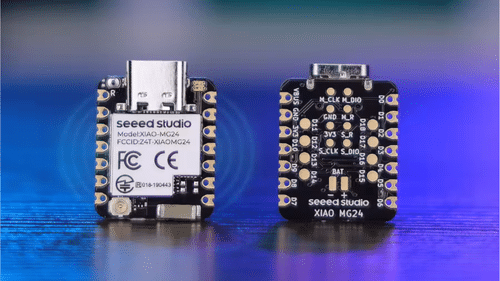
The Seeed Studio XIAO MG24 can now be used to develop Zigbee applications through the Arduino IDE following the release of Silicon Labs Arduino Core 5.0. The update adds a dedicated Zigbee library alongside existing Matter and Bluetooth support, expanding the connectivity options available to developers using the Arduino environment.
The XIAO MG24 is built around Silicon Labs’ EFR32MG24 SoC, which combines an Arm Cortex-M33 processor with a 2.4-GHz wireless radio. The board measures 21 × 17.8 mm, making it suitable for compact connected devices. The XIAO MG24 Sense variant additionally integrates an analogue microphone and a six-axis inertial measurement unit (IMU).
Matter, Thread, Zigbee, and Bluetooth Low Energy (BLE) use the wireless hardware of the EFR32MG24, while the selected protocol stack and application firmware determine how the radio operates. Silicon Labs provides the corresponding development support through its Arduino core, allowing developers to configure the board for different connectivity applications without changing to a different processor platform.
Core 5.0 adds Zigbee support for several common smart-home device types. These include on/off and dimmable colour lights, smart plugs, switches, contact sensors, temperature and humidity sensors, light sensors, power sources, and time synchronisation. The Matter implementation supports a broader range of documented device categories, including water valves, thermostats, door locks, occupancy sensors, air-quality sensors, contact sensors, illuminance sensors, pressure sensors, smart plugs, and dimmable lighting.
A typical Zigbee application can configure the XIAO MG24 as a temperature and humidity sensor and connect it to a compatible Zigbee coordinator. Developers can install the Silicon Labs board package in Arduino IDE, select the appropriate XIAO MG24 configuration and Zigbee protocol option, and then use the available Zigbee examples as the starting point for an application.
The Zigbee coordinator can be a compatible USB adapter connected to a home-automation platform or a commercial smart-home hub. Once the board is configured and the appropriate example is uploaded, it can be commissioned onto the Zigbee network and used to report sensor data. The reporting interval can then be adjusted according to the application’s requirements.
The Silicon Labs Arduino core includes the Matter and Zigbee libraries and example sketches for supported boards. Seeed Studio also provides documentation covering the XIAO MG24 hardware and its initial setup, while the Arduino-based workflow provides a familiar development environment for students and makers experimenting with wireless applications.
Low-power operation is another relevant feature for sensor applications. Seeed Studio specifies typical current consumption of 1.95 µA in low-power mode and 6.71 mA during normal operation. These figures are general board specifications rather than Zigbee-specific measurements. Actual consumption can vary with the selected protocol, firmware, radio activity, connected peripherals and operating conditions.
The addition of Zigbee does not mean that a single application operates as a Matter, Thread, Zigbee, and Bluetooth device simultaneously. The selected protocol stack and firmware determine how the wireless hardware is used for a particular application. Developers therefore configure the board according to the connectivity protocol required for each device.
The Zigbee implementation also provides an opportunity to compare different approaches to connected sensor design. For example, the same temperature and humidity sensor could be implemented using Zigbee and Matter over Thread, with network-join time, reporting reliability, power consumption and battery life measured under identical conditions.
For Indian makers, the choice between these technologies can depend on the smart-home hardware already in use. Zigbee is supported by a wide range of smart-home devices, while Matter is being adopted across newer connected-device ecosystems. With Zigbee development now available through Silicon Labs Arduino Core 5.0, developers can build custom Zigbee devices using the same Arduino-based environment used for other supported wireless applications.
The XIAO MG24 operates in the 2.4-GHz ISM band, with operation in India subject to applicable wireless regulations and technical conditions. For commercial products, developers need to check the current WPC requirements and any product-specific compliance requirements before deployment.
For more information, click here.