




A new lutetium-ion optical clock has reached 19-digit precision, with researchers reporting record-low uncertainty that could contribute to a future redefinition of the second.
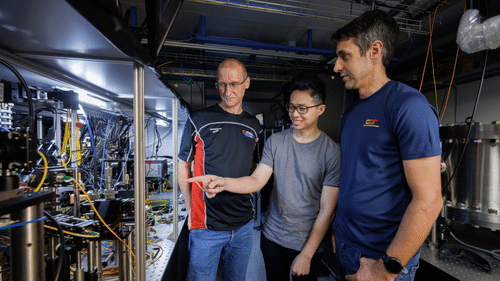
Physicists in Singapore say they have built the most accurate atomic clock reported to date. The team at the Centre for Quantum Technologies at the National University of Singapore (NUS).
Accurate clocks sit quietly behind daily life. Phone maps, bank transfers, power grids, and mobile networks all rely on precise, synchronised time. More accurate reference clocks can improve these systems while enabling more sensitive scientific measurements.
Most clocks use a pendulum or quartz crystal to mark time. An optical atomic clock works at a much higher frequency, using a laser tuned to a precise transition between two energy states in an atom. By measuring the frequency of the light involved in that transition, the clock can maintain an extremely precise reference.
The NUS clock uses singly charged lutetium-176 ions (^176Lu+) held in place by electric fields. The team says lutetium’s heavy atomic mass and the properties of its relevant electron states make the clock less sensitive to heat radiation and stray magnetic fields, which are important sources of uncertainty in optical clocks. The work was led by Associate Professor Murray Barrett, a principal investigator at the Centre for Quantum Technologies.
The NUS release gives the clock’s uncertainty as 1 × 10⁻¹⁹, the lowest reported for an optical atomic clock. The Nature paper gives total systematic uncertainties of 1.2 × 10⁻¹⁹ and 1.3 × 10⁻¹⁹ for the two clocks. When the researchers compared the two clocks, their frequencies agreed to 5.7 × 10⁻¹⁹ after 200 hours of measurements.
Put loosely, a fractional frequency uncertainty of 1 × 10⁻¹⁹ corresponds to an error of roughly one second over 317 billion years. This is an illustrative calculation rather than a figure reported by the research team.
The world’s official second is still defined using caesium atomic clocks, which operate at microwave frequencies. Optical clocks, including those based on ytterbium, strontium, aluminium and other atoms or ions, have achieved much lower uncertainties and are being considered for a future redefinition of the second.
The previous record cited by the NUS researchers was a 4.4 × 10⁻¹⁹ systematic uncertainty achieved with a cryogenic ^40Ca+ ion optical clock. The result was reported by researchers in China in Physical Review Letters in February 2026.
With systematic uncertainties of 1.2 × 10⁻¹⁹ and 1.3 × 10⁻¹⁹ for its two lutetium clocks, the NUS result represents roughly a fourfold improvement over that previous result.
This is a laboratory instrument, not a commercial product. The result is based on measurements made by the NUS team and will need to be independently reproduced and compared by other groups. “I am confident that what we have now is the most accurate clock in the world,” Barrett said in the NUS release.
The team plans to use the clock to investigate fundamental physics and detect tiny changes in Earth’s gravitational field. The result could also contribute to the international effort to redefine the second, which is expected to be considered from 2030 onwards. In the longer term, the researchers aim to develop a transportable version of the clock.
India’s official time is maintained by CSIR-National Physical Laboratory (CSIR-NPL) in New Delhi, which generates and disseminates Indian Standard Time using its atomic-clock systems. CSIR-NPL is also developing an optical frequency standard based on a single trapped ^171Yb+ ion as part of its research into next-generation time standards.
The development is relevant as international metrology moves towards a possible optical definition of the second. India’s national metrology infrastructure will need to maintain traceability to any revised definition, making optical frequency standards an important area of research. The Singapore result shows the level of precision now being achieved in optical timekeeping research in Asia.
For more information, click here.


