

A microSD-card-sized RISC-V development board plugs into a USB port to provide an affordable open source platform for bare-metal firmware development.
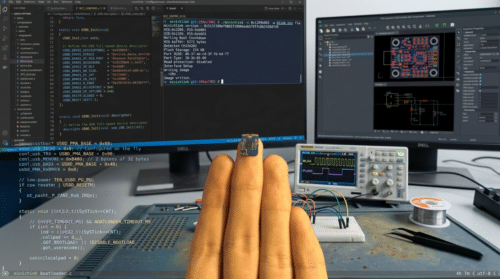
Icy Electronics has introduced Comu, a compact development board based on WCH’s CH32V203 reduced instruction set computer five (RISC-V) microcontroller. Measuring 13 × 9.4 mm and weighing 0.4 grams, the board is small enough to connect directly to a universal serial bus (USB) port without a cable or adapter. It is slightly smaller than a microSD card and includes two light-emitting diodes (LEDs), four capacitive touch buttons and six general-purpose input/output (GPIO) connections exposed through test pads. The hardware and firmware are also published as open source designs.
Comu uses the single-core, 32-bit CH32V203 RISC-V MCU, which runs at up to 144 MHz and provides 20 KB of SRAM and 224 KB of Flash. The Flash is divided into a 64KB zero-wait region and 160 KB of standard Flash, while a separate 24 KB boot-memory area is available for boot functions. Comu’s USB bootloader occupies 2 KiB of that region. The board is powered directly from the USB connection, with Icy Electronics specifying around 49.3 μA/MHz in run mode and 19.4 μA/MHz in sleep mode.
Comu continues the developer’s line of miniature boards designed to plug directly into USB ports. The family began with the Arm Cortex-M0+-based Tomu in 2018 and later included FPGA-based Fomu and Qomu boards and the Somu security key. Comu brings a RISC-V microcontroller to the series. It is listed at $5.99 on Tindie and $5.88 on Lectronz, with the Tindie version including a 3D-printed case.
The board is designed for low-level embedded development, with the developer reporting that a basic LED-blinking programme can compile to around 40 bytes. Its custom 2-KiB USB bootloader leaves approximately 22 KiB of the 24-KiB boot-memory area available, alongside the MCU’s main Flash. Developers can program the CH32V203 using bare-metal C/C++ through the open-source ch32fun project, Rust through ch32-hal, Arduino IDE or WCH’s MounRiver Studio. The complete hardware design files, including KiCad schematics and printed circuit board (PCB) layouts, are available on GitHub, while the PCB can also be viewed through KiCanvas.
With its direct-USB form factor, RISC-V processor and open hardware design, Comu provides a compact platform for experimenting with bare-metal firmware, USB applications and embedded development. Its published design files also allow developers to inspect, modify and build upon the hardware.