

A humanoid robot that reuses Android smartphones for vision, motion sensing and computing, potentially lowering hardware costs and making robotics research more accessible to students.
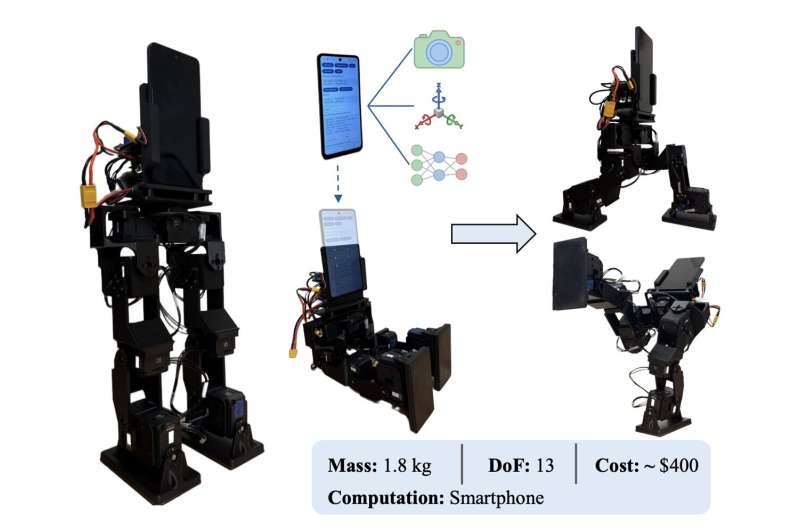
A smartphone-powered humanoid robot developed by researchers at the University of California, Los Angeles (UCLA) demonstrates how existing consumer electronics can reduce the cost and complexity of robotics development. Called PhoneBot, the 48cm-tall robot uses an Android smartphone for camera-based vision, motion sensing and movement-control computation, eliminating the need for several dedicated electronic components. Its hardware costs approximately $400, excluding the smartphone.
The phone is mounted above the robot’s hips and serves as its main sensing and computing unit. Its camera detects and tracks people, while built-in motion sensors provide information about movement and orientation. The smartphone runs the control software and sends movement commands over Wi-Fi to an onboard computer, which relays them to the motors.
PhoneBot has 13 motors, with six in each leg and one additional motor to rotate the torso. This arrangement allows the robot to turn its camera towards a person while keeping its feet planted. Initial demonstrations showed that it could walk, track a person and recover from a face-down position.
The researchers tested the system with four Android smartphones, including a 2017 Honor 9, a Moto G 2025, a Samsung Galaxy A16 5G and a Moto G 2024. The phones supported the core vision, sensing and movement-control functions, indicating that robotics experiments may not require expensive flagship devices. However, the Honor 9 could not run the robot’s mapping feature because the required Google services were unavailable.
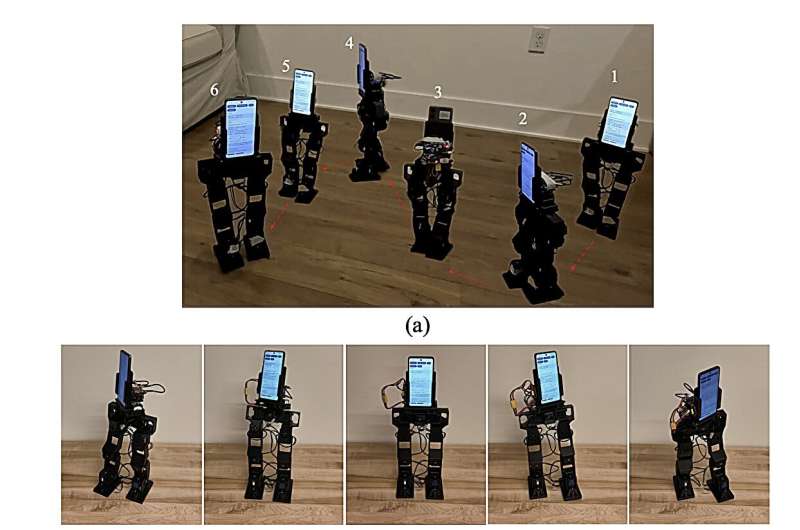
A key development challenge was training the walking controller. The researchers trained the software in simulation while accounting for the limited strength of the motors. They also mirrored training examples by swapping left and right movements. This improved learning speed and consistency in simulation while helping distribute motor loads more evenly between the legs.
The platform builds on the earlier OpenBot project, which used smartphones to control wheeled robots. PhoneBot extends the concept to bipedal movement, where balance and coordination introduce additional engineering challenges.
The robot currently lacks arms and has been tested on flat terrain. Speech interaction is supported, but speech recognition and language processing rely on an external laptop. Future work will explore uneven-terrain walking, lightweight arms and running language models directly on the phone. The researchers intend PhoneBot to serve as an open-source platform for affordable robotics education and experimentation.