




A solid polymer electrolyte developed by South Korean researchers improves sodium-metal battery safety while retaining more than 90 per cent of its capacity after 1000 charge cycles.
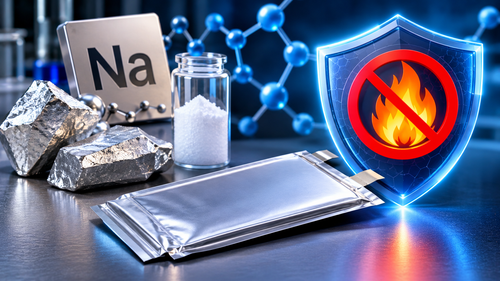
Sodium is abundant and cheap, which may make it a replacement for lithium in batteries. Nevertheless, batteries with sodium metal suffer from safety concerns, as sodium metal is very reactive and regular electrolytes used in batteries may be flammable. Scientists at Chonnam National University in South Korea created a solid polymer electrolyte that could solve those issues.

The research team headed by Professor Chan-Jin Park used three components, namely, sodium perchlorate as a source of sodium ions, N-isopropylacrylamide (NIPAM), and succinonitrile. The mixture of all three is considered a deep eutectic solvent that is characterized by high thermal stability and nonflammability. But in liquid form, the solvent is prone to leakage from the battery. So, the team made it a solid polymer electrolyte.
This resulted in the formation of electrolyte having sodium-ion conductivity of 1.39 millisiemens per centimetre (mS/cm) at 30°C and sodium-ion transference number of 0.58. When used in a full cell, the initial discharge capacity of the electrolyte was 110.2 milliamp hours per gram (mAh/g) at a charge of 0.1C, while the Coulombic efficiency was 99 per cent. When charged at a 2C charging rate, it had 90.4 per cent capacity retention after 1000 cycles. The researchers also reported resistance to direct flame and reduced unwanted side reactions and uneven sodium deposition, which can shorten battery life.
This group also showed a pouch cell that kept working while being folded and cut. While this experiment demonstrates the robustness of the structure, no data is available on the capacity and cycling behavior of this specific battery.
Traditional organic liquid electrolytes used in sodium-metal batteries may be volatile, flammable, and toxic. Replacing them with a solid electrolyte could improve battery safety. “Our electrolyte combines efficient Na ion transport with improved safety,” Park said. He also suggested that the design could lead to “safer, lower-cost and more sustainable rechargeable batteries”.
The research remains at the laboratory stage, and further testing will be needed to establish how the electrolyte performs in larger cells and under practical operating conditions. Park identified grid storage, backup power, and low-cost rechargeable systems as potential applications. Although sodium is abundant, the study does not provide a manufacturing cost estimate. The next challenge is scaling up the technology and demonstrating that its performance can be maintained in larger battery cells.
For more information, click here.

