




A tandem solar cell keeps over 90 per cent of its efficiency under shading, reducing reverse-voltage damage and improving the life of thin-film solar panels.
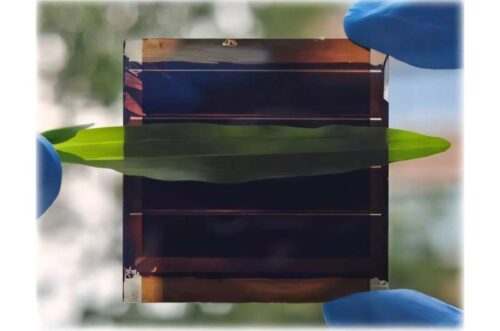
A research team at The Hong Kong Polytechnic University (PolyU) has developed a perovskite–organic tandem solar cell that remains highly efficient even under severe reverse-bias conditions caused by partial shading. The device retained more than 90 per cent of its original power-conversion efficiency after exposure to -40V reverse bias, addressing one of the major reliability challenges facing thin-film solar technologies.
Partial shading from trees, buildings, clouds or debris can force shaded solar cells into reverse bias, creating a negative voltage that reduces power output and may permanently damage thin-film solar modules. Improving reverse-bias tolerance is therefore important for extending the operating life of these solar cells in real-world installations.
The researchers traced the problem to deep trap states in the bulk heterojunction layer of organic solar cells. These defects trap charge carriers, leading to irreversible degradation. By reducing isolated acceptor clusters within the active layer, the team minimized these defects and increased the irreversible breakdown voltage to over -35V, allowing the cells to withstand much higher stress.
The improved organic solar cells were integrated into perovskite–organic tandem solar cells, where they also protected the perovskite layer during operation.
The devices also showed long-term stability. They maintained 90 per cent of their initial efficiency after operating at -20V for 12 hours and 97 per cent after 2,000 hours at -4.5V, indicating strong resistance during prolonged testing.
In addition to improved durability, the tandem cells achieved power-conversion efficiencies exceeding 26 per cent, building on the team’s earlier work that reported a certified efficiency of 25.1 per cent in 2025.
The researchers also demonstrated the technology in scalable tandem solar cell minimodules, suggesting that the approach could be suitable for practical solar modules.

