




Solar windows make electricity from sunlight and indoor light. They let light enter buildings and help reduce electricity use while generating power.
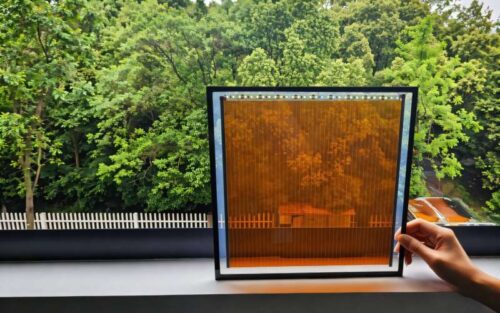
Researchers from the UCL Institute for Materials Discovery, working with an international team, have developed a semi-transparent solar cell that can be built into windows to generate electricity from both sunlight and indoor lighting. The technology could help buildings produce power during the day, on cloudy days, and even under artificial lighting at night.
The study, published in Advanced Energy Materials, describes a solar window that allows about 30% of sunlight to pass through while converting both indoor and outdoor light into electricity. The team reported an energy conversion efficiency of 22% under bright indoor lighting (1,000 lux) and 14% under sunlight.
The solar cells are based on perovskite, a material that can be tuned to absorb the wavelengths of indoor light more effectively than conventional silicon. Using computer modelling, the researchers optimized the thickness and arrangement of each layer to balance transparency with power generation.
The light-absorbing perovskite layer was only 185 nanometres thick—around 500 times thinner than a human hair and much thinner than the layers used in typical perovskite solar cells. The team also added a molecule called 3-trifluoromethyl-1H-1,2,4-triazole, which reduced defects that trap electrons and improved the stability of the crystal structure, helping the device maintain its performance over time.
To improve transparency, the researchers redesigned the cell’s electrode. Instead of using a standard gold electrode that blocks light, they placed a thin gold layer between two transparent molybdenum oxide layers. This reduced light reflection and allowed more light to pass through while still conducting electricity.
The researchers built a 30 cm × 30 cm solar panel to demonstrate the technology. During durability testing, the device retained 80% of its original efficiency after 300 hours of continuous light exposure.
The team says the technology could eventually be made into flexible films that can be applied to building windows, vehicle glass, sunroofs, or other transparent surfaces. Besides generating electricity, the semi-transparent cells also reduce the amount of sunlight entering a building, which could lower the energy needed for air conditioning in warm climates.
