




Researchers created a spider-inspired rescue robot that can autonomously track, approach and retrieve people or objects on water, potentially accelerating emergency response efforts.
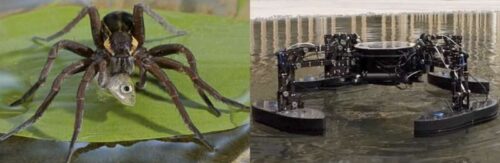
Researchers from the Shenzhen Institute of Artificial Intelligence and Robotics for Society (AIRS) in China and the Stevens Institute of Technology in the United States have developed QuadBoat, a spider-inspired unmanned surface vehicle designed to track, approach and retrieve people or objects during water rescue operations. The prototype aims to support search-and-rescue teams by reducing response times and assisting in hazardous environments where rapid intervention is critical.
The four-legged robotic boat takes inspiration from fishing spiders, which can move swiftly across water surfaces using long, water-repellent legs that distribute their weight. Rather than copying the spiders’ biology directly, the researchers adapted their agile movement principles into a robotic platform capable of travelling efficiently while remaining stable on the water.
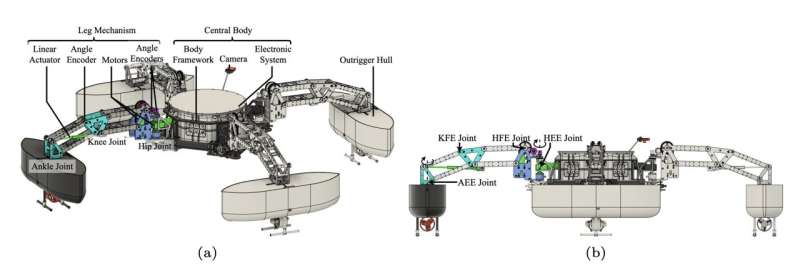
QuadBoat combines a central body with four independently controlled legs. Its movement is governed by an inverse kinematics controller, while additional steering and stabilisation algorithms help maintain accurate navigation across the water. According to the researchers, the control system enables the robot to track designated targets, adjust its posture dynamically and retrieve floating objects with precision.
In trials conducted in a swimming pool, the robot successfully executed planned movements, followed predetermined routes and located selected floating targets. It also demonstrated the ability to collect and transport objects while maintaining stable operation. The researchers reported that trajectory tracking, object-following accuracy and overall manoeuvrability met the design objectives established for the prototype.
The team believes the technology could eventually assist emergency responders during real-world rescue missions, particularly in coastal regions, lakes and rivers where reaching victims quickly is essential. Future work will focus on testing the robot in more challenging water conditions and refining its sensing and control systems. If successful, the spider-inspired design could provide rescue teams with an autonomous tool capable of locating, tracking and recovering victims more efficiently while reducing risks for human responders.
