




The hybrid system combines direct liquid spraying with partial immersion to reduce coolant use while controlling battery temperatures.
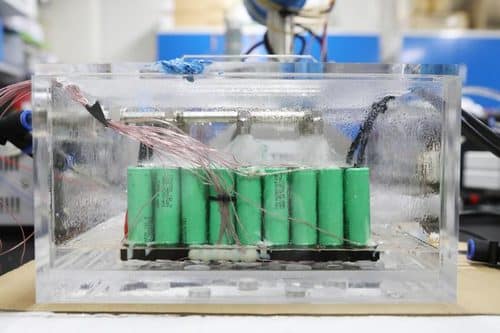
Managing heat during rapid charging remains a challenge for electric vehicle batteries and energy storage systems. Conventional cooling methods, such as air channels and aluminium cold plates, can struggle to remove heat under high electrical loads. A research team led by Dr Jinsub Kim at the Korea Institute of Machinery and Materials (KIMM) has developed a spray-based immersion cooling system that reduces dielectric fluid use while maintaining battery temperatures.

Immersion cooling is carried out through the submersion of whole battery modules into a non-conductive dielectric fluid. While this method ensures efficient heat exchange, it involves the use of considerable amounts of coolant fluid, thus adding to the weight of the system. The KIMM method uses both liquid spraying and partial immersion.
Dielectric fluid is sprayed on the upper part of the lithium-ion battery cells using precision nozzles, whereas the bottom part of the batteries stays partially submerged in a small reservoir of liquid. This method utilises both spray cooling as well as forced convection cooling through liquid immersion. Testing revealed that such an approach allowed reducing the consumption of dielectric fluid by up to 85 per cent.
The researchers tested the system on a 9S7P battery pack at charge and discharge rates ranging from 1C to 4C, with coolant flow rates of 2 to 4 litres per minute. The spray-based configuration achieved the lowest maximum cell temperatures and the smallest temperature difference among the tested configurations. At a 4C discharge rate, the maximum temperature was around 34°C. At higher coolant flow rates, the system also reduced peak temperature by up to 19 per cent compared with conventional flow-based immersion cooling.
The researchers say the findings could help reduce the amount of dielectric fluid required for battery thermal management. However, the results are based on experimental testing of a battery pack, and further work is needed to establish the system’s performance in commercial electric vehicles and larger energy storage installations.
The experiment has also shown that spray cooling can be potentially used in applications where there is a need for high-rate battery usage, such as electric vehicles and data center back-up power sources. Further research and analysis would be required to establish its applicability in such cases.
For more information, click here.


