What if you could build microscopic patterns without carving the material? Researchers have shown a way to do that while improving terahertz performance.
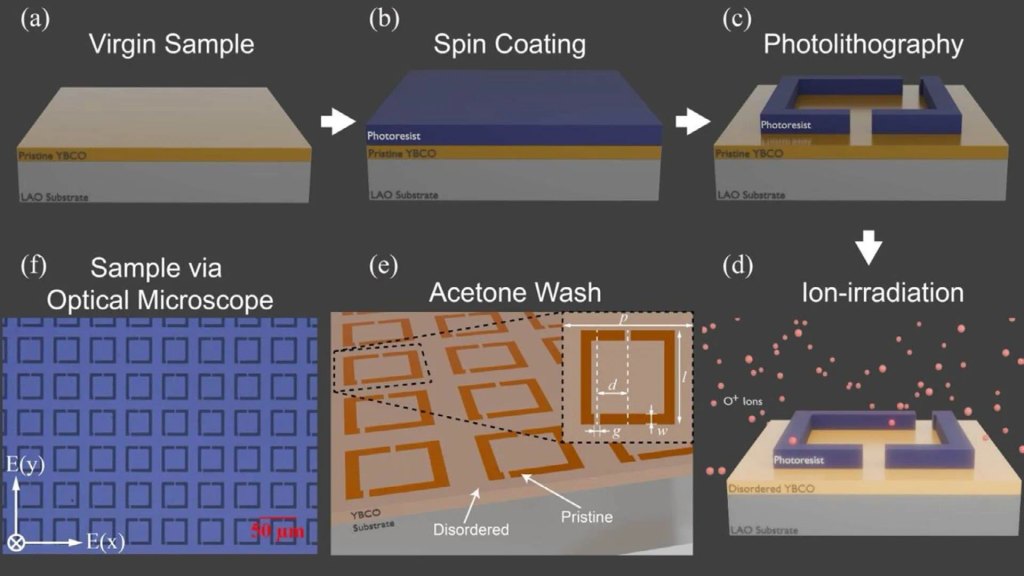
Researchers from Nanyang Technological University, IIT Hyderabad, PSL Research University, and the University of Notre Dame have demonstrated a way to fabricate superconducting metamaterials without physically etching away parts of the material. The technique uses oxygen ions to selectively disable superconductivity in specific regions, allowing terahertz structures to be formed while keeping the underlying film physically intact.
The approach addresses a fabrication problem that becomes particularly important with superconductors. Conventional wet and dry etching can introduce rough edges, surface disorder, oxygen depletion, and lattice defects. These changes can degrade superconducting behaviour, limiting the performance of devices built from materials such as yttrium barium copper oxide (YBCO). Avoiding physical removal could therefore help preserve the properties needed for low-loss, high-frequency devices.
The researchers used photolithography to protect selected portions of a superconducting thin film before exposing the unprotected areas to high-energy oxygen ions. The irradiation disrupts the crystal structure enough to suppress superconductivity in those regions, effectively turning them into dielectric sections. The remaining superconducting regions form the required metamaterial pattern without creating etched edges or gaps in the film.
The resulting structures showed stronger resonance and greater frequency tunability than comparable wet-etched superconducting metamaterials. The researchers also demonstrated rapid optical control of the devices. Ultrafast laser pulses can disturb Cooper pairs in the superconductor, changing its response to terahertz radiation, while the original state returns as the pairs reform within a few trillionths of a second. This behaviour could enable terahertz filters and optical switches to be controlled at very high speeds.

The researchers believe the fabrication method could help develop low-loss components for terahertz communications, sensing, and quantum technologies. By replacing material removal with controlled changes in superconductivity, the technique offers a different route to manufacturing microscopic high-frequency structures.