




A maker built wireless belts from ESP32-C3 boards and motion sensors so two children control a Raspberry Pi running game by physically jumping and ducking.
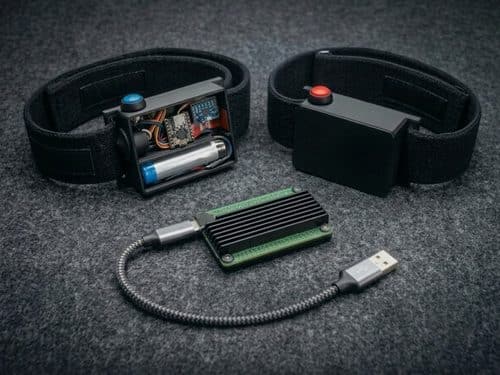
A maker has built a gaming system that replaces traditional controllers with something much more physical: two wearable motion belts. The project, called Move to Play, uses movement from the players to control a two-player game running on a Raspberry Pi, turning actions such as jumping and ducking into game inputs.
The idea came from a simple observation. Instead of children sitting on a sofa while playing another screen-based game, the maker wanted to create something that would encourage them to get up and move. The result is a two-player setup in which each player wears a belt and controls an on-screen character through body movements.
The project is documented as an eight-step build on Instructables, with photographs showing the construction and setup process. Rather than requiring a conventional gamepad, the system uses wearable motion sensing to translate physical activity into commands for the game.
Each player gets a dedicated belt-based controller. The wearable unit detects movement and sends the resulting control input to the Raspberry Pi, which runs the game and displays the action on a connected screen. This creates a simple interaction loop: move in the real world and the character responds on the screen.
The concept is particularly interesting because the controller becomes part of the game rather than simply being an input device held in the player’s hands. Jumping can become an in-game action, while ducking can trigger another response. This also means that two children can play together without sharing a conventional controller.
The project is aimed at making the gaming experience more active rather than replacing physical activity with another sedentary pastime. It also demonstrates how relatively accessible electronics and a small single-board computer can be combined to create an interactive gaming system.
The Raspberry Pi acts as the central computer, handling the game while receiving movement information from the two wearable controllers. Because the game logic runs locally, the setup does not require a cloud service for the basic gaming experience.
The belt concept also leaves room for modification. The same basic approach could be adapted for other movement-controlled games, fitness challenges or educational activities. A game could, for example, count repeated movements, turn different body actions into different controls or introduce competitive challenges between two players.
For makers, the project demonstrates an important idea in human-machine interaction: the body itself can become the controller. Motion sensors can capture physical actions and convert them into digital commands without requiring a keyboard, mouse or traditional gamepad.
That makes the build particularly relevant for educational environments. Students could use a similar project to learn about sensors, wireless communication, embedded programming and game development while producing something that can be demonstrated immediately. Instead of simply displaying sensor readings on a serial monitor, the physical movement produces a visible result inside a game.
The project also shows why Raspberry Pi and microcontroller-based builds remain useful for experimenting with alternative interfaces. A conventional controller is designed around buttons and joysticks, while a wearable system opens up a much larger interaction space. The same hardware concept could potentially be used for gesture-controlled games, interactive exercise systems or other projects where physical movement needs to become a digital input.
There are practical limitations, however. Motion-based controls need to distinguish deliberate actions from accidental movements, and different players may move differently. A system intended for children would also need its sensitivity tuned so that normal movement does not repeatedly trigger unwanted commands.
The build is therefore more than just another DIY gaming project. It demonstrates how inexpensive embedded electronics can turn a television or monitor into an interactive physical-play system. Instead of asking children to remain still while controlling a character, the game makes their own movements part of the gameplay.
For makers and educators, that provides an interesting starting point for experimenting with wearable electronics. The original project provides the complete step-by-step build and photographs for those who want to reproduce or modify the system.
For more information, click here.
