What if flexible electronics could assemble themselves? A thin-film design demonstrates modules that can connect, disconnect and work together autonomously.
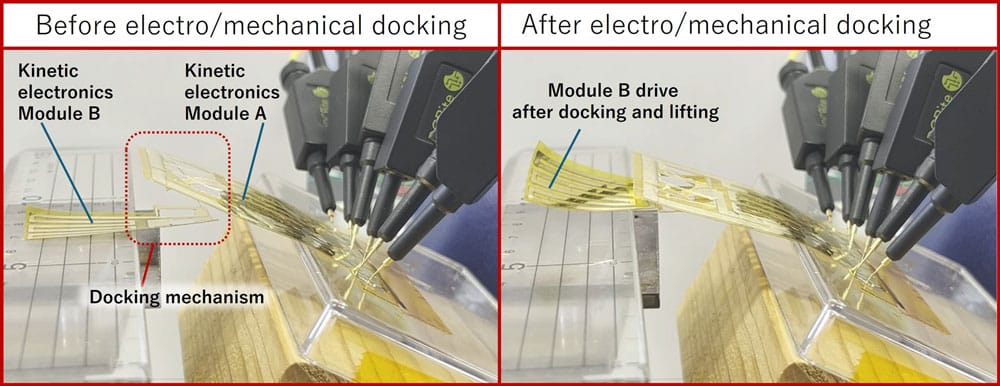
Kyushu University researchers have developed prototype thin-film electronic modules that can automatically connect and disconnect with one another, enabling flexible electronic systems that can be reconfigured without conventional connectors. The work is part of an ongoing research into “kinetic electronics” that combines electronic circuits with actuators on thin-film devices.
The technology is aimed at applications such as wearable sensors, soft robotics and medical devices, where conventional electronics are typically built as fixed, single-piece systems. By allowing individual modules to attach, detach and function together, the approach could support adaptable electronic systems that are easier to reconfigure for different tasks.
The prototype integrates an actuator and an electrical circuit on the same thin film. Its actuator layer combines polypropylene and polyimide, materials with different thermal expansion rates, along with a gold microheater. When electrical power is applied, the microheater raises the temperature, causing the thin film to bend. This motion enables the modules to align and establish both mechanical and electrical connections.
The researchers demonstrated multiple docking mechanisms, including a loop-and-hook design and a claw-based connector that remains mechanically locked even after power is removed. Once connected, one module can supply power to another through the docking interface, allowing it to activate and deform independently. In one demonstration, a kinetic electronics module connected to, lifted and powered a second thin-film circuit module.
“These devices are still in their early stages, so there are many things we need to work on. I hope this research leads to the development of devices that can, like living organisms, self-assemble, adapt, and even repair themselves,” says Associate Professor Fumihiro Sassa, Faculty of Information Science and Electrical Engineering at Kyushu University.