
A sodium-ion home battery claims up to 30,000 charge cycles, while usable energy depends on inverter compatibility and settings.
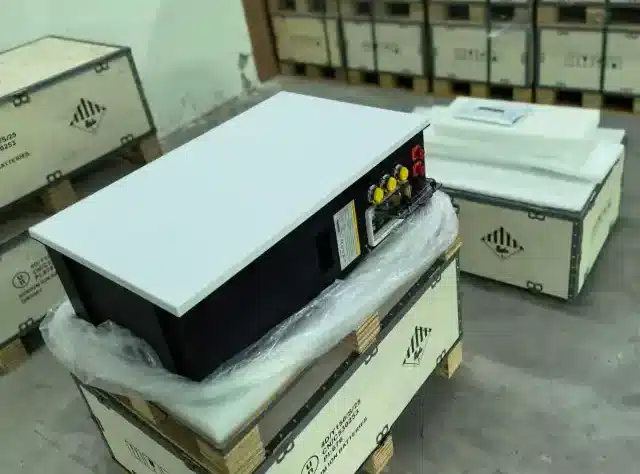
A sodium-ion residential energy storage system from Bulgaria-based AuroraCell is available from a warehouse in Poland. The battery uses sodium-ion chromium oxide (NCO) chemistry and is designed for residential energy storage with compatible low-voltage, 48V-class hybrid inverters. The company says the system is intended for applications including solar energy storage, photovoltaic self-consumption and backup power.
The battery was initially reported as a 9.7kWh residential energy storage system (RESS), but AuroraCell’s current product page lists it as a 9.3kWh unit with a nominal voltage of 46.4V and a capacity of 200Ah. The company explains that the 9.7kWh figure represents gross nominal cell-level energy, calculated using cells with a nominal capacity of 210Ah and the pack’s nominal voltage of 46.4V (210Ah × 46.4V = 9,744Wh, or 9.744kWh, rounded to 9.7kWh). In contrast, 9.3kWh is the specified usable energy of the complete battery system at 100 per cent depth of discharge under reference conditions. The two figures therefore describe different energy definitions. Neither figure guarantees the AC energy delivered to household appliances.
Inverter compatibility affects how much of the specified usable energy can be accessed. AuroraCell says accessing the full 9.3kWh requires a compatible, correctly configured inverter that allows discharge down to the battery’s 32V lower operating limit. A nominal 48V designation alone does not establish compatibility; the inverter’s voltage range, communication protocol and battery settings must also be suitable.
AuroraCell’s approximate battery-side reference figures indicate usable energy of 9.30kWh at a 32V lower cut-off, 8.80kWh at 36V, 8.10kWh at 40V and 7.70kWh at 42V. Actual delivered energy depends on temperature, discharge current, wiring losses, battery management system (BMS) settings and inverter efficiency. The AC energy supplied to the home will be lower because of conversion losses. Installers should verify model-specific compatibility and the inverter’s lower discharge-voltage cut-off before integrating the battery into an existing solar installation.
AuroraCell’s current product page advertises a projected cycle life of up to 30,000 cycles. The original launch report, however, cited 20,000 cycles at 100 per cent depth of discharge and 25°C. The company states that the current 30,000-cycle projection is based on cell-level test data and a lifetime projection under defined operating conditions. It is a manufacturer claim, not evidence of a completed 30,000-cycle test of the complete residential battery system. AuroraCell also advertises a 20-year performance warranty and describes the battery as designed for a 25-year lifetime. These claims should be distinguished from independently verified long-term performance.
The current product page lists a charging current of 50A and a maximum discharge current of 100A. It specifies dimensions of 477 × 269 × 803mm, a weight of 110.5kg and an IP55 protection rating. The battery supports CAN, RS485 and RS232 communication interfaces, and up to 15 units can be connected in parallel to expand storage capacity. These figures correspond to the current product listing and should not be combined with specifications from the original launch report without confirming that they refer to the same version.
AuroraCell offers a matched 12kW three-phase hybrid inverter with a battery voltage range of 30–60V. The company says other low-voltage hybrid inverters may also be suitable, provided their voltage range, communication protocol and battery settings are compatible. Installers should check the exact inverter and battery versions before connecting the system.
The company describes its battery architecture as prioritising safety through its sodium-ion chemistry, battery management system and thermal design. However, these descriptions do not establish that fire or other battery hazards are impossible. Buyers should request the relevant test reports and compliance documentation for the exact product version being supplied.
Sodium-ion batteries use sodium ions to carry charge between electrodes. Sodium is widely available, making the chemistry an alternative for manufacturers seeking options beyond lithium-based energy storage. However, practical suitability depends on more than chemistry: usable capacity, round-trip efficiency, purchase price, warranty conditions, installation requirements and independently verified lifetime performance also influence a battery’s value.
AuroraCell’s current product page confirms availability from its Polish warehouse but does not list a price. Given the differences between the original launch report and the current product specifications, prospective buyers should obtain the latest datasheet and confirm the usable capacity, cycle-life claims, warranty terms and inverter compatibility before ordering.
For more information, click here.