

Physicists have found that monitoring a quantum battery’s environment could help it deliver more usable energy than keeping it completely isolated.
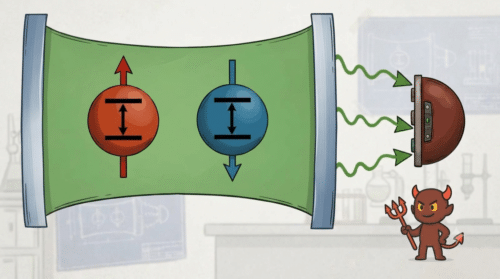
Physicists at the University of Insubria and INFN in Como, together with teams from the University of Genova and CNR-SPIN and the University of Milan, have found that continuously monitoring a quantum battery’s environment can increase the amount of stored energy that can be extracted. The approach turns environmental interaction, normally treated as a limitation, into a potential advantage for quantum battery operation.
Unlike a conventional battery that stores energy through chemical reactions, a quantum battery stores energy in the quantum states of systems such as atoms or spins. Its main advantage is the potential for much faster charging, since multiple components can be charged collectively rather than individually. Recovering that energy is another challenge, however. The amount of useful work that can be extracted from a quantum system is known as ergotropy, and it is generally lower than the system’s total stored energy.
During charging, the quantum battery interacts with its charger and the two systems can develop quantum correlations. These correlations link their quantum states, meaning some of the energy becomes associated with the combined battery-and-charger system rather than the battery alone. Once the charger is disconnected, that part of the energy cannot be extracted from the battery independently, reducing the amount of usable energy available from the charge.
Quantum environments are usually treated as a source of noise that can disrupt fragile quantum states, but the Insubria-led team took the opposite approach. By continuously monitoring the environment and using the measurement data as it arrives, the researchers showed that the correlations formed between the battery and charger can be reduced. This leaves less energy tied to the combined system and allows more of the stored energy to be extracted from the battery alone. The mechanism was demonstrated using two theoretical models: a cavity-mediated spin-spin quantum battery and a Dicke quantum battery, where multiple two-level systems interact collectively with a single light field.
The striking part of the result is that monitoring the battery’s environment does more than compensate for energy normally lost through environmental interactions. The researchers report that continuous monitoring can enhance work extraction beyond what is achievable in an ideal closed-system battery. In other words, a quantum battery that interacts with its environment but is continuously observed can outperform the same type of battery operating in perfect isolation. The paper’s quantitative results depend on the model and parameters used, so no single improvement percentage is given here.
This remains theoretical work rather than a laboratory demonstration or a working quantum battery. The results come from analytical calculations and numerical modelling of two idealised quantum-battery systems, with no physical device built or tested. Putting the approach into practice would require equipment capable of continuously monitoring the quantum environment and using that measurement record to control the battery. The broader energy cost of performing measurements, processing the resulting information and resetting the measurement apparatus would also need to be considered when assessing a practical system. Practical quantum batteries therefore remain a long-term prospect despite the improvement demonstrated in the models.
India has no dedicated quantum-battery programme, but research relevant to the field sits within the National Quantum Mission, which supports quantum computing, communication, sensing and quantum materials and devices. The mission has an outlay of INR 6,003.65 crore over eight years, covering 2023–24 to 2030–31, with four thematic hubs led by IISc Bengaluru, IIT Madras, IIT Bombay and IIT Delhi. Research in quantum thermodynamics is also being pursued in India, including work on topics such as work extraction and the thermodynamic aspects of quantum systems. TIFR, meanwhile, has research activity in quantum measurement and control, providing a related connection to the measurement techniques discussed in the study.
The finding does not make quantum batteries any closer to powering phones or cars. Instead, it challenges the idea that a quantum device’s environment must always be isolated, showing that carefully monitoring those interactions could become part of how future quantum systems are controlled.
For more information, click here.