




Tiny magnetic beads implanted in muscles track movement, offering a new way to help people control artificial limbs more accurately.
To track muscle movement accurately, MIT researchers have used tiny magnetic beads implanted in the muscle. The research is useful for people with certain types of amputation to control their prosthetic limbs. The team believes that their magnetic tracking system will enable the commercial development of such limbs.

The MIT team has demonstrated the accuracy of magnetic measurements in 3 participants who have below-knee amputations. “This interface is minimally invasive, so it could be accessible to more people. You place two beads in the muscle, and you have access to all of this rich information about the muscle dynamics,” says Christopher Shallal, an MIT graduate student in the Harvard-MIT Program in Health Sciences and Technology and one of the lead authors of the paper.
The approach is known as magnetomicrometry. In this technique, pairs of magnets are implanted into muscles. When a muscle contracts or stretches, external sensors placed on the skin can measure the change in distance between the magnets, allowing muscle length and velocity to be calculated.
Participants had magnets implanted in up to four muscles of the ankle joint. The surgeries were performed at Brigham and Women’s Hospital in collaboration with plastic surgeon Matthew Carty, a co-author of the study. The beads are 3 millimetres in diameter, about the size of a sesame seed. The magnets are made from an alloy of neodymium, iron, and boron, and are coated with gold and a polymer called parylene C to make them biocompatible.

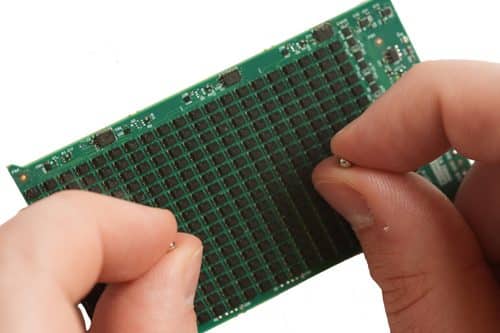
The magnetic signals can be read from a depth of up to 6 centimetres from the skin’s surface using a customised external sensor that is worn over the skin and positioned over the muscles that are being tracked.
During the experiments, the participants were not wearing a prosthetic limb but were asked to perform tasks such as moving a cursor on a screen to a particular target using their muscle movements. Using each of the three measurement techniques, the signals generated by the muscle movements were translated into control signals that, in this case, moved the cursor but could, in the future, be fed into the controller of a robotic ankle-foot prosthesis.