




Researchers have developed ultra-compact memory switches that could reduce chip size, lower power consumption and enable more capable 5G and future 6G radio systems.
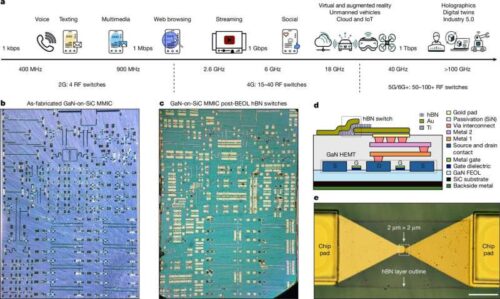
The National University of Singapore (NUS) has developed compact memristive radio-frequency switches that could significantly reduce the size and power requirements of 5G and future 6G radio-frequency chips. The research demonstrates a new way to integrate tiny memory switches directly into gallium nitride (GaN) microchips, potentially allowing more wireless functions without increasing chip size.
Modern wireless systems require far more radio-frequency switches than previous generations. While a typical 2G system used only a handful of switches, 5G and future 6G hardware may require between 50 and more than 100, increasing chip size, manufacturing costs and energy consumption.
The new switches are fabricated from hexagonal boron nitride (hBN) and integrated onto commercially manufactured GaN chips. Unlike conventional transistor- or diode-based switches that require continuous power to maintain their operating state, the memristive devices retain their configuration after receiving a brief electrical pulse. This non-volatile behaviour reduces the energy needed to operate wireless hardware while freeing valuable chip space.
Each switching element measures just 2 × 2 micrometres, around 25,000 times smaller than conventional radio-frequency switches cited in the study. Researchers integrated the devices into existing GaN circuitry without redesigning the underlying transistor layer, demonstrating compatibility with established semiconductor manufacturing processes.
Testing showed the switches operated at frequencies of up to 100GHz, covering bands used by 5G and under evaluation for 6G communications. The best-performing switch recorded a signal loss of only 0.3 decibels, allowing approximately 93 per cent of signal power to pass through. The devices also retained their conducting state after two weeks of storage and after 24 hours at 175°C, indicating strong thermal stability.
Although further work is required to improve manufacturing methods and long-term durability before commercial deployment, the research demonstrates that ultra-compact memory switches could help deliver smaller, more energy-efficient radio chips for future wireless networks, smartphones, connected vehicles and advanced communications infrastructure.


