




A one-gram robot uses a tiny motor to control jump height, recover after landing, and repeat hops, offering new possibilities for miniature robotic mobility systems.
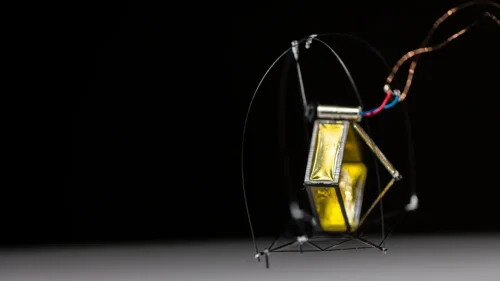
The University of Washington has developed DirectHop, a one-gram hopping robot that uses a tiny electric motor instead of springs to control jump height and recover after landing. The research demonstrates a compact approach to obstacle-crossing for miniature robots, with the prototype able to clear a standard stair step and prepare for repeated jumps.
Most small hopping robots use mechanisms inspired by fleas, where springs store energy before releasing it rapidly. Although this arrangement can produce large jumps, spring-and-latch systems offer limited control over jump distance and become increasingly difficult to manufacture as robots shrink.
DirectHop replaces this mechanism with direct motor actuation. A tiny motor is connected to a central tower using a fishing line. When the motor accelerates, it winds the line and moves up the tower, pulling the robot into the air. Three folding legs extend during the jump to maintain alignment with the robot’s foot. Adjusting the electrical current supplied to the motor allows the researchers to control the jump height with approximately 1cm precision.
The robot also incorporates a roll cage and active motor movement to recover after landing on its side. By shifting its centre of gravity, DirectHop can return to an upright position and prepare for another jump. Tests achieved successful self-righting on approximately 90% of attempts, while the robot demonstrated multiple sequential hops.

The current prototype remains externally powered and cannot steer towards a specific destination. The researchers are developing onboard solar cells and batteries, vibration-based steering, adjustable feet, cameras, and electronics for autonomous navigation. These additions could support applications such as industrial inspection, agricultural monitoring and planetary exploration.
The team will present the work at the International Conference on Intelligent Robots and Systems (IROS 2026). The research remains a prototype demonstration, with further development required for fully autonomous operation.


