A new ultra-low-power companion IC autonomously manages sensors and peripherals, reducing unnecessary MCU wake-ups and helping battery-powered edge devices operate longer with lower energy consumption.
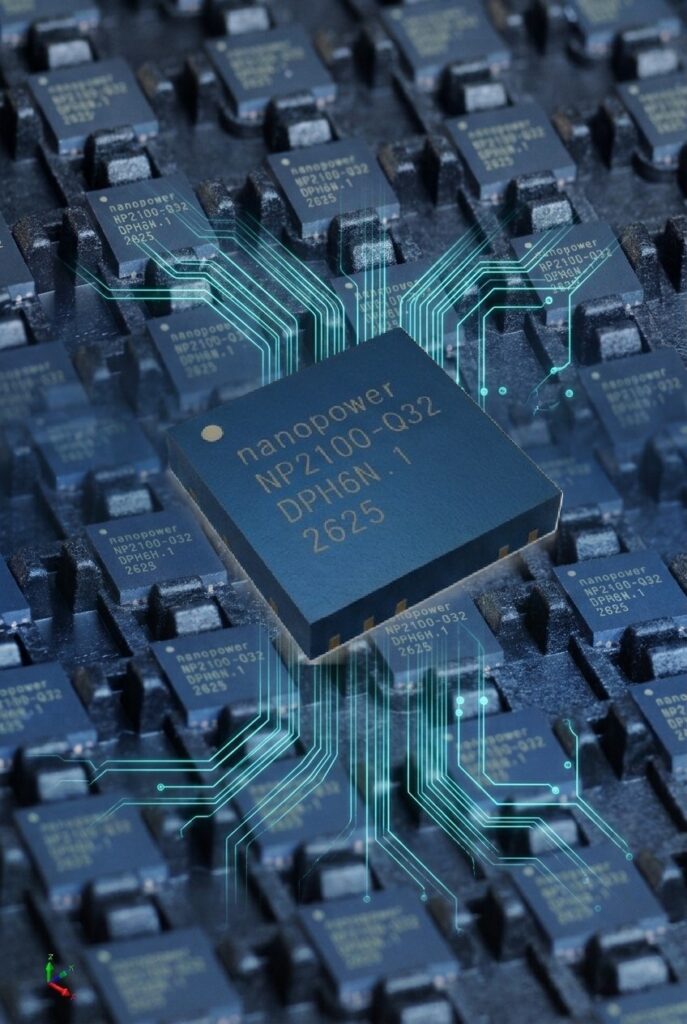
Nanopower Semiconductor has introduced the nPZ2100, an ultra-low-power power-saving IC designed to reduce energy consumption in battery-powered sensor and edge systems by keeping the main processor switched off until meaningful processing is required.
The IC expands the company’s nPZero platform by taking responsibility for routine sensor monitoring, peripheral control and event detection. Instead of repeatedly waking a power-hungry MCU to check sensors or system conditions, the nPZ2100 can perform these tasks independently and activate the host only when a predefined event requires further processing.
This approach addresses a growing challenge in connected edge electronics. While MCUs, wireless SoCs and AI processors increasingly offer sophisticated low-power modes, unnecessary wake-ups and continuously powered peripherals can still consume a significant portion of a system’s energy budget.
The nPZ2100 operates with a typical idle current of 200 nA at 3 V and a polling current of 1 µA. It can autonomously communicate with up to six independent peripherals through I²C or SPI interfaces, while integrated power switches allow the device to selectively control peripheral and host power domains.
The key features are:
- 200 nA typical idle current
- 1 µA sensor polling consumption
- Controls up to six peripherals
- Integrated peripheral and host power switches
- Industrial −40°C to +85°C operation
Its architecture combines sensor and event management with local processing resources, including SRAM, an analogue-to-digital converter, timing functions, and event monitoring. These capabilities allow designers to implement a “sense, decide, wake and process” architecture, where the primary MCU remains powered down during routine monitoring.
The IC can also switch off unused peripherals, reducing their standby consumption alongside the energy saved by limiting MCU activity. This makes the device particularly relevant for electronics that spend long periods waiting for changes in environmental, sensor or user-generated conditions.
Potential applications include wireless IoT sensors, smart home devices, building automation systems, asset trackers, electronic shelf labels, security products and battery-powered industrial sensors. The technology can also support wearables, remote controls, human-interface devices and energy-harvesting systems where available power is tightly constrained.
Operating across an industrial temperature range of −40°C to +85°C, the nPZ2100 is aimed at both consumer and industrial designs. Development kits and engineering samples are planned for September 2026, with volume manufacturing targeted for Q2 2027.
Click here for the original announcement.