




The carrier board adds dual MIPI-CSI camera inputs, MIPI-DSI display connectivity and three 3.5-mm audio interfaces to compatible UNO Q and VENTUNO Q boards.
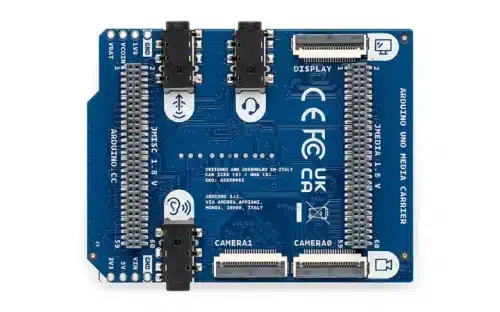
Arduino has released the UNO Media Carrier (ASX00083), a new carrier board that expands the multimedia connectivity of the UNO Q and VENTUNO Q single-board computers. It provides direct access to camera, display and audio interfaces that are otherwise exposed through the boards’ 60-pin JMEDIA and JMISC connectors. The carrier uses 22-pin MIPI connectors and standard 3.5-mm audio jacks, making these interfaces more accessible for hardware development.
For imaging, the board provides two 22-pin, four-lane MIPI-CSI connectors compatible with cameras such as the IMX219, including the Raspberry Pi Camera Module 2. The display section uses a 22-pin MIPI-DSI connector supporting four-lane MIPI-DSI displays, including compatible 5-inch, 8-inch and 10.1-inch touch displays. This allows the UNO Q or VENTUNO Q to be connected directly to external camera and display hardware without requiring separate interface adapters.
The audio section includes three dedicated 3.5-mm connectors: a combined microphone input/headphone output, a line-out connection and an ear-out connection. The latter provides Class-AB differential earpiece output.
Both JMEDIA and JMISC connectors use a passthrough design, keeping the host-board signals available for additional modules or carriers. The exposed interfaces include CCI I2C at 1.8 V, MCU I2C4 at 3.3 V, an 8-bit PSSI parallel camera interface, SoC GPIO at 1.8 V and MCU GPIO at 3.3 V. The board also includes four RGB LEDs.
Power can be supplied from the host board through JMEDIA and JMISC, while a separate 7–24 V DC input is available through a four-pin header. A 3.0 V VCOIN input is also provided for the host board’s RTC, with a maximum of 3.6 V. The carrier measures 68.58 × 53.34 mm and is specified for operation from −10°C to 60°C.
The hardware is accompanied by pinout documentation, a datasheet, PDF schematics, Altium CAD files and STEP files, making the board relevant for hardware development and integration. Arduino also provides a tutorial for connecting the UNO Q and the carrier to a Waveshare MIPI-DSI touchscreen.
For more information, click here.


