

The system uses low-power sensor nodes to estimate rainfall from raindrop vibrations.
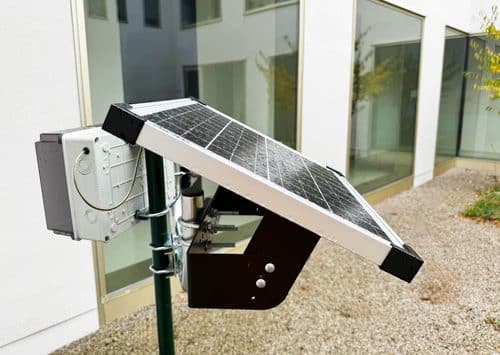
A German research team has found a way to use solar panels to measure rainfall. Researchers from the Fraunhofer Institute for Digital Media Technology (IDMT) in Ilmenau have attached structure-borne sound sensors to solar modules to measure vibrations caused by raindrops hitting the panels.

Vibrations of the modules are caused by raindrops, and the sensors capture these vibrations. Each sensor unit utilizes a machine learning algorithm that runs on an energy-efficient microcontroller to estimate rainfall. Only compact measurement data needs to be transmitted wirelessly. Pan Acoustics, the project partner based in Wolfenbüttel, developed the sensor-node hardware and wireless transmission technology. Data from multiple locations is collected and analysed centrally at Fraunhofer IDMT to build a more detailed picture of local rainfall. Since the sensors do not have any moving parts, maintenance requirements may be reduced.
The experiment was first conducted using a laboratory-based rain simulator. Various rainfall rates, drop sizes, and photovoltaic modules were used in the test. It then installed three outdoor measurement systems at the IDMT courtyard, Pan Acoustics and the weather garden of the Technical University of Ilmenau. For light rain between 2 and 5 mm/h, the system recorded a mean absolute deviation of 1.88 mm/h against reference measurements. Fraunhofer says this meets Class C of the World Meteorological Organization’s (WMO) accuracy classification for low rainfall intensities, which allows a maximum deviation of 2 mm/h.
Heavy rain remains an important limitation. The team does not yet have enough training and test data for high rainfall intensities to establish how accurately the system performs under those conditions. “We have proven the feasibility of our approach for light rain,” said Jakob Bergner, group leader for Smart Acoustic Solutions at IDMT and scientific head of the project.
This technology is meant to support traditional systems of rain gauges instead of replacing them. Some applications of this technology can be urban digital twins, municipal control rooms, and flood monitoring. According to Fraunhofer, the operators of municipal infrastructures and firefighting brigades have shown interest in such a tool for rainfall measurement.
In field trials, the wireless link was able to cover a distance of four kilometers in urban settings and over 35 kilometers in rural settings in line of sight mode. Before data is transmitted, it is processed in each sensor node.
Project lokalRAIN took place between October 2024 and June 2026 as part of Germany’s Central Innovation Program for SMEs (ZIM). It resulted in a prototype that is not a marketable product yet. More work will be necessary to improve the housing of the sensor and its electronic components and to perform quality assurance of the system.
Next on the list of priorities would be gathering more data during heavy rains and testing the technology in varying environmental situations. Without this information, the technology can only be considered a possibility for additional local rainfall data rather than a substitute for traditional rain gauges.
For more information, click here.