

Korean researchers have demonstrated wireless power transfer to a soft cardiac implant that maintained more than 50 per cent efficiency despite stretching and misalignment in animal tests.
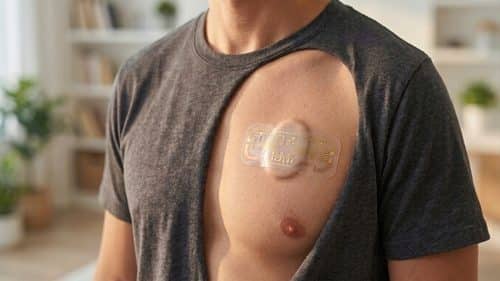
A wearable transmitter could eventually power an implanted cardiac device through the skin without requiring a battery inside the implant. Researchers in South Korea have developed a wireless power-transfer system that maintains stable energy delivery even when the transmitter and implant move out of alignment or the implant stretches.
The work, published in Nature Electronics on 25 September 2026, combines a wearable self-oscillating transmitter with a stretchable liquid-metal receiver. The researchers demonstrated wireless cardiac pacing and tachyarrhythmia termination in rabbit and pig models. The system has not been tested in humans.
How the wireless link works
Conventional inductive wireless power transfer depends on the transmitter and receiver remaining sufficiently aligned and close to their designed resonance. Movement, deformation and changes in the electrical load can disturb that condition and reduce power delivery.
The researchers addressed this using a nonlinear parity-time (PT)-symmetric circuit. Its wearable transmitter uses real-time feedback to automatically adapt its operating frequency to changes in the receiver’s resonance. This allows the system to maintain power transfer as the implant’s position or electrical conditions change.
The implant uses a stretchable liquid-metal receiver. Its deformable structure is designed to reduce resistance-related power losses when the receiver is stretched. Together, the transmitter and receiver form a wireless link designed to tolerate mechanical variation.
What the tests showed
The researchers reported more than 50 per cent power-transfer efficiency when the receiver was subjected to 30 per cent strain and 30 mm of misalignment. This combination of deformation and spatial displacement is important because an implanted device can move relative to a wearable transmitter as the body moves.
In a porcine model, the system supported wireless cardiac pacing with axial separation of up to 40 mm. Additional tests demonstrated operation with lateral misalignment of up to 30 mm. The researchers also demonstrated termination of tachyarrhythmia using the wireless pacing system.
Why battery-free implants matter
Implantable cardiac devices traditionally require an internal power source. Once an implanted battery reaches the end of its useful life, a procedure is generally required to replace the pulse-generator component.
A wireless power system could reduce the need to place a large battery inside some future implants, but it introduces a different requirement: the external transmitter must remain available to deliver power. In this demonstration, the wearable power-management unit uses an 11 V lithium-ion battery.
The researchers’ approach is intended to address one of the main limitations of conventional wireless links: their sensitivity to changes in distance, alignment, deformation and load impedance.
Maturity and limitations
This remains a laboratory research demonstration rather than a clinical pacemaker. The researchers tested the system in animal models and have not demonstrated it in humans. The wearable transmitter also has to remain positioned on the body to supply power.
Further development would need to address long-term operation, implant safety, reliability, tissue compatibility and practical wearable use before such a system could be considered for clinical applications.
What it means for India
India’s growing medical-device sector could eventually benefit from technologies that reduce the size and maintenance requirements of implantable electronics. However, this research is still at the animal-testing stage, so its relevance to Indian clinical devices remains a future possibility rather than an established application.
For Indian researchers and medical-device developers, the work demonstrates how wireless power, stretchable electronics and adaptive resonance control can be combined to address movement-related power-transfer problems in implanted electronics.
For more information, click here.