

A wristwatch-type sensor combines printed ion-selective electrodes, rapid-stabilising reference technology, and wireless electronics to track sodium and potassium signals in sweat during everyday activities.
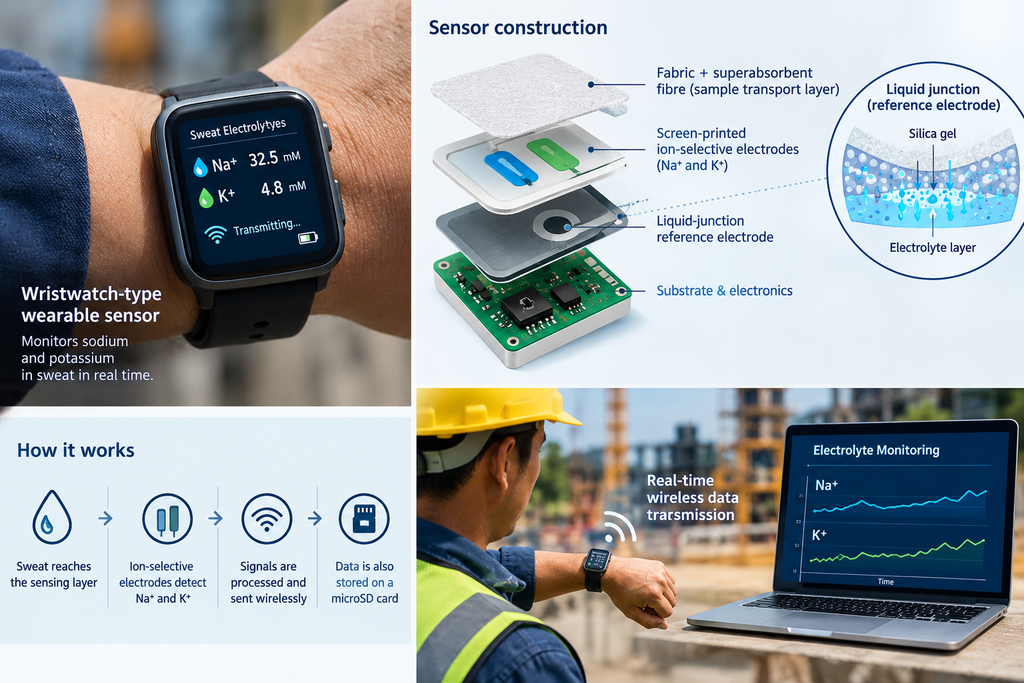
A wristwatch-type wearable sensor developed by researchers at Tokyo University of Science, Japan, can monitor sodium and potassium signals in sweat in real time, potentially supporting hydration management for workers and athletes exposed to heat. The device integrates screen-printed electrodes, a specialised reference electrode, and wireless electronics to collect and transmit measurements without interrupting normal activities.
Led by Associate Professor Isao Shitanda, the research team addressed a key limitation in wearable electrolyte sensors: the time conventional printed reference electrodes need to stabilise before producing reliable measurements. These sensors use a potentiometric method, in which the voltage generated by an ion-selective electrode changes according to the concentration of a target ion. A stable reference potential is essential for interpreting these voltage changes accurately.
The new design incorporates a screen-printed liquid-junction reference electrode alongside separate sodium- and potassium-selective electrodes. Its liquid junction contains silica gel, which allows water to permeate the electrolyte layer and helps the reference electrode stabilise rapidly, reducing the need for lengthy preconditioning.
The sensing assembly also includes a sample-transport layer made from fabric and superabsorbent fibre. Positioned over the electrodes, this layer helps wet the sensing region and transport sweat across the sensing area. This arrangement supports the collection of ion-responsive signals as sweat reaches the electrodes.
Wireless Electronics Enable Field Monitoring
The researchers integrated the sensing components with a custom wristwatch-type electronic unit capable of processing signals, transmitting data wirelessly to a host computer, and storing measurements locally on a microSD card. Combining wireless communication with onboard storage allows data to be collected and retained during field operation.
To evaluate the system outside the laboratory, the team tested it at an active construction site. A construction worker wore the device during normal work activities, including breaks, meals, and hydration. The sensor recorded sodium- and potassium-responsive signals for approximately 2 hours and 45 minutes, transmitting them wirelessly while simultaneously saving them locally.
The technology could eventually support hydration monitoring and occupational safety in construction, manufacturing, sports, and outdoor work. Combining electrolyte measurements with information such as sweat volume and water intake could help develop more comprehensive monitoring systems for hot environments. Screen printing may also enable economical fabrication and scalable production.
However, the current results demonstrate field operation rather than fully validated quantitative sweat analysis. Controlled sweating experiments and further validation are needed before the device can reliably determine electrolyte concentrations under different conditions. The study establishes a foundation for wearable biochemical monitoring, with further work required to translate the prototype into a dependable health-management tool.