Researchers at Huazhong University of Science and Technology have developed sustainable, cost-effective, and eco-friendly batteries using redox-organic electrode materials in aqueous electrolytes.
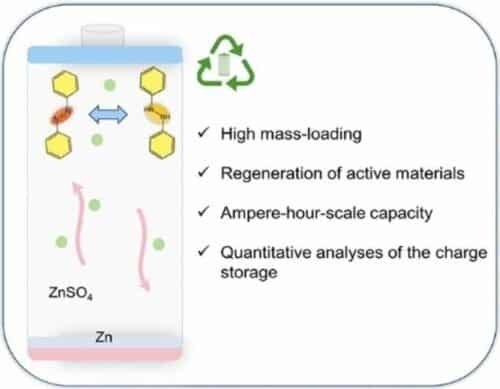
Modern rechargeable batteries like lithium-ion ones are unsustainable. Organic batteries made from natural materials with redox-organic electrode materials (OEMs) are a possible alternative. Inorganic electrodes have a resource, toxicity, environmental, mining, capacity, recycling, and cost issues that hinder the development of large-scale sustainable batteries for the energy transition.
Researchers at Huazhong University of Science and Technology have made progress in using OEMs in batteries with aqueous electrolytes, which are more sustainable, cost-effective, and environmentally friendly than conventional organic electrolytes in lithium-ion batteries. The aqueous organic batteries are easy and cheap to recycle.
The team have chosen Azobenzene due to its low cost and high solubility in organic solvents while being insoluble in water. The molecule contains an azo group (–N=N–) that can transfer two electrons reversibly, resulting in a high capacity. During discharge, the azobenzene absorbs two electrons and is converted into hydroazobenzene through two protons’ rapid, reversible binding. Analyses indicate that the material has high capacity due to the reversible transfer of two electrons.
Prototypes of coin and laminated pouch cells using azobenzene OEMs and zinc counter-electrodes achieved ampere-hour scale capacities that remained stable over 200 charge and discharge cycles. Compared to polymeric OEMs, the small azobenzene molecules can be easily recycled by extracting them with commercial organic solvents.
The electrode material is stable in the air when charged or discharged and can be recycled with over 90% yield in any state of charge. The recycled products can be reused as OEMs without capacity loss. The researchers believe this represents a significant advancement towards practical applications of OEMs.
Reference : Yuan Chen et al, A Recyclable and Scalable High‐Capacity Organic Battery, Angewandte Chemie International Edition (2023). DOI: 10.1002/anie.202302539