

Engineers at the University of California San Diego have created a prototype of a wearable that can track many health metrics in real time, including glucose, alcohol, and lactate levels.
The device is about the size of six quarters stacked together. It’s applied to the skin with a Velcro-like patch of minuscule needles, or microneedles, each approximately the width of a human hair. The gadget is not uncomfortable to use since the microneedles only penetrate the skin’s surface to detect biomolecules in the interstitial fluid, which is the fluid that surrounds the cells beneath the skin. The device is worn on the upper arm and delivers data to a special smartphone app via Bluetooth.
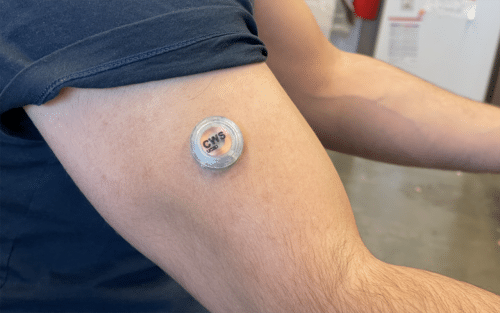
“This is like a complete lab on the skin,” said center director Joseph Wang, a professor of nanoengineering at UC San Diego and co-corresponding author of the paper. “It is capable of continuously measuring multiple biomarkers at the same time, allowing users to monitor their health and wellness as they perform their daily activities.”
“With our wearable, people can see the interplay between their glucose spikes or dips with their diet, exercise and drinking of alcoholic beverages. That could add to their quality of life as well,” said Farshad Tehrani, a nanoengineering Ph.D. student in Wang’s lab and one of the co-first authors of the study.
The wearable consists of a microneedle patch connected to a case of electronics. Different enzymes on the tips of the microneedles react with glucose, alcohol and lactate in interstitial fluid. These reactions generate small electric currents, which are analyzed by electronic sensors and communicated wirelessly to an app that the researchers developed. The results are displayed in real time on a smartphone. An advantage of using microneedles is that they directly sample the interstitial fluid, and research has shown that biochemical levels measured in that fluid correlate well with levels in blood.
The disposable microneedle patch may be easily removed from the electronic enclosure for replacement. The battery, electronic sensors, wireless transmitter, and other electronic components are all housed in the reusable electronic case. Any wireless charging station for phones and smartwatches can be used to recharge the device.
Click here to have a demonstration on YouTube.