





A new wearable-to-implant wireless power system maintains energy delivery despite movement, stretching, and misalignment, potentially enabling battery-free soft medical implants for cardiac applications.
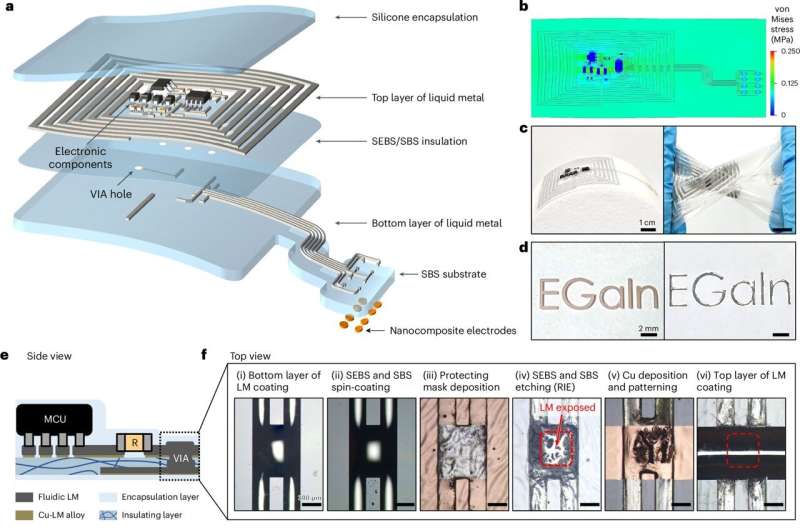
Researchers at the Institute for Basic Science (IBS), Seoul National University and other institutions in South Korea have developed a wireless power-transfer (WPT) system designed to keep soft medical implants powered even as the devices move, stretch, or change their position inside the body. The system combines a wearable transmitter with a stretchable liquid-metal receiver and was demonstrated in a wireless cardiac pacemaker.
The key challenge is maintaining a stable wireless link when the distance and alignment between the external transmitter and implanted receiver continuously change. Conventional inductive WPT systems can lose efficiency when their coils become misaligned. This becomes particularly difficult for soft implants designed to conform to moving organs and tissues.
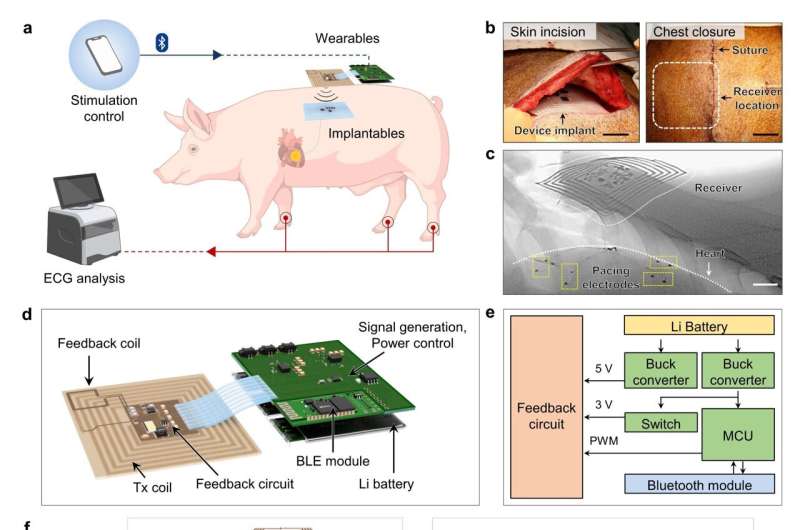
The researchers addressed this using a parity–time-symmetric (PT-symmetric) circuit. The wearable transmitter uses a self-oscillating architecture that can adapt to variations in the wireless link, while the implant incorporates a stretchable receiver made using liquid-metal conductors. This allows the receiving circuit to retain electrical functionality while mechanically deforming.
Unlike rigid implant electronics, the receiver can accommodate strain while maintaining wireless energy coupling. The approach therefore targets one of the limitations of soft bioelectronics: mechanical flexibility can improve tissue conformity but simultaneously makes conventional power-transfer links less predictable.
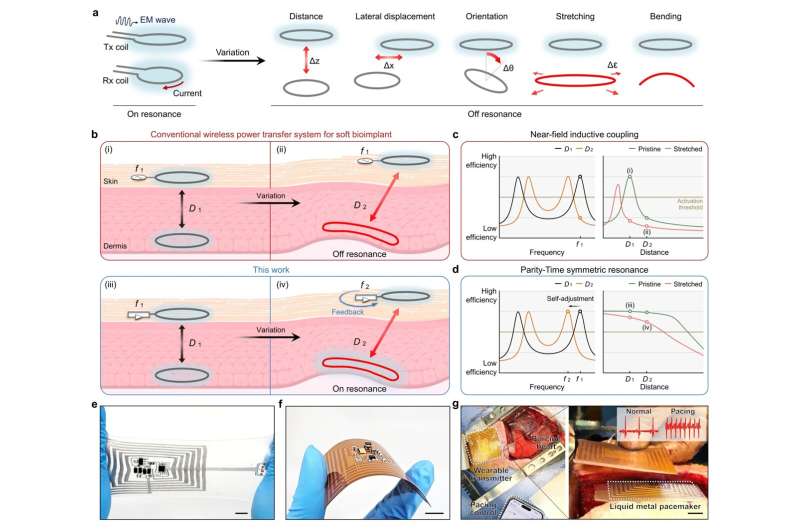
The team initially integrated the technology into a wireless leadless pacemaker. Tests in rabbit and pig models showed that the system could continue delivering power during changes in distance, alignment, and mechanical strain, enabling untethered cardiac pacing.
The architecture could be relevant to other battery-free or battery-reduced implants, including devices that need to operate continuously while conforming to moving biological structures. Eliminating or reducing reliance on implanted batteries could also reduce the need for replacement procedures.
However, practical deployment will require further optimisation of power-transfer efficiency, implant miniaturisation, tissue safety, long-term reliability, and the alignment between wearable and implanted electronics. The work indicates that mechanically adaptive wireless power links could become an important enabling technology for next-generation soft and stretchable medical electronics.

