




Imagine storing valuable information in something as simple as glass. It sounds futuristic, but researchers believe it could preserve data for thousands of years.
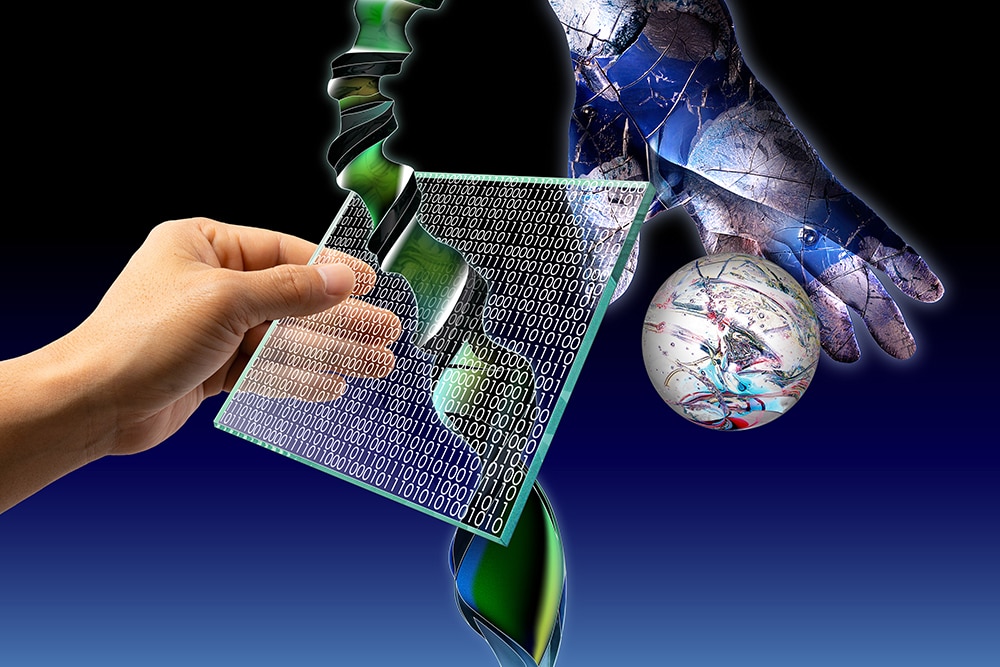
In today’s world, data has become one of our most valuable resources. Data is generated at almost every stage of modern life. As a result, preserving it securely and without degradation over long periods is not only a technical challenge but also an increasingly urgent necessity. Recently, a group of Microsoft researchers claimed that a glass sheet can preserve encrypted data for more than 10,000 years. On 18th February, Nature published the study. The researchers demonstrated that a sheet of borosilicate glass measuring 12cm wide and 2mm thick can store 4.8 terabytes of data, the equivalent of about 2 million books.
How did they achieve this?
Researchers at Microsoft used high-powered lasers to create tiny distortions within three-dimensional structures in borosilicate glass to embed hidden data. The encoded information could later be read using an optical microscope.
The idea of writing data onto glass or other durable media using lasers is not new. It is a maskless microfabrication technique in which complex three-dimensional nanostructures are created using high-energy focused laser pulses lasting femtoseconds (10–15 seconds). These tiny holes formed within the glass act as individual data storage units.
These storage units are known as voxels, the three-dimensional counterparts of pixels. One advantage of using lasers is that voxels can be packed densely by concentrating energy into an extremely small area. The storage capacity of each voxel can be increased further by adjusting the laser polarisation. Once written, the encoded data can be read using an optical microscope.
Why do scientists prefer glass?
Glass is better suited for long-term data storage because it can withstand changing temperatures, humidity, electromagnetic fields and chemical reactions far better than conventional storage media.
However, encoding data traditionally requires multiple laser pulses for each voxel, making the process relatively slow. To overcome this limitation, researchers from Microsoft’s Silica project developed two different types of voxels: phase voxels and birefringent voxels.
In the first case, data is stored by changing the refractive index through isotropic changes in the glass. In the second, the voxel is polarised through anisotropic changes. Both types of voxels can be created using a single laser pulse, significantly improving efficiency. Using this method, researchers can create up to ten million voxels per second, allowing 25.6 million bits of data to be encoded every second.
Kazansky and his colleagues developed the underlying physics behind laser-writing technology and thus achieved the Guinness World Record for the most durable digital preservation using fused silica glass. In 2017, Microsoft began developing its Project Silica technology based on its work. Although fused silica is more durable and capable of storing data at higher densities, recent research has shown that Microsoft instead uses relatively inexpensive borosilicate glass, which is easier to manufacture. Researchers have also found experimentally that using four laser beams in parallel significantly speeds up the writing process.
At present, pen drives and hard drives remain the most common tools for everyday data transfer. Most modern storage devices rely on magnetic technology, storing information by creating different magnetic patterns on thin metal layers inside magnetic tapes and hard drives. However, as temperatures rise over time, the magnetisation of these tiny magnetic regions gradually weakens, making long-term data storage less reliable.
By contrast, once information is stored in glass, it is extremely difficult to erase and requires little ongoing maintenance or temperature control. Scientists have calculated that even at temperatures of about 290°C, the stored data remains unaltered. As a result, once data is written onto the glass, it can be preserved for an exceptionally long time.
Mark Bathe, a biotechnologist at the Massachusetts Institute of Technology, described this glass-based data storage system as an excellent solution for long-term archival storage. Many experts believe the technology could become an important option for preserving valuable digital records far into the future.
However, the biggest limitation is that the glass-based system is non-rewritable and unsuitable for storing frequently accessed data, making it impractical for everyday storage or data transfer. Even so, researchers remain optimistic that continued advances will expand its practical applications in the years ahead.

