

What happens when AI, missile defence, cyber warfare, and national security merge into one integrated shield? Mission Sudarshan Chakra offers a glimpse.
Operation Sindoor succeeded in neutralising the designated terror targets without collateral damage. However, the operation exposed capability gaps and vulnerabilities. Enemy drones were able to penetrate Indian airspace, though in limited numbers, to strike border civilian areas, revealing shortcomings in low-altitude air defence, counter-drone measures, and rapid point protection systems.
Lack of coordination across radar networks and communication systems prevented the consistent, seamless integration of air, space, cyber, and electronic warfare assets. Several advanced sensors and weapon systems, despite being effective independently, failed to integrate fully into a unified real-time defence grid.
Fault lines observed included inadequate electronic warfare capability, limited cyber and drone warfare capacity, insufficient counter-unmanned systems, the unavailability of military-grade drones capable of surviving in GPS-denied and contested environments, siloed systems, service-specific processes, and limited ability to adapt quickly to changing operational needs.
The gaps revealed underscore the urgency of building a self-reliant, scalable, next-generation, multi-layered air and missile defence network. This strategic imperative set the stage for Mission Sudarshan Chakra, conceptualised with inspiration drawn from the mythological Sudarshan Chakra wielded by Lord Krishna, the epic symbol of a divine, multi-layered weapon that struck with precision and always returned to its wielder, embodying resilience, control, and protection against threats.
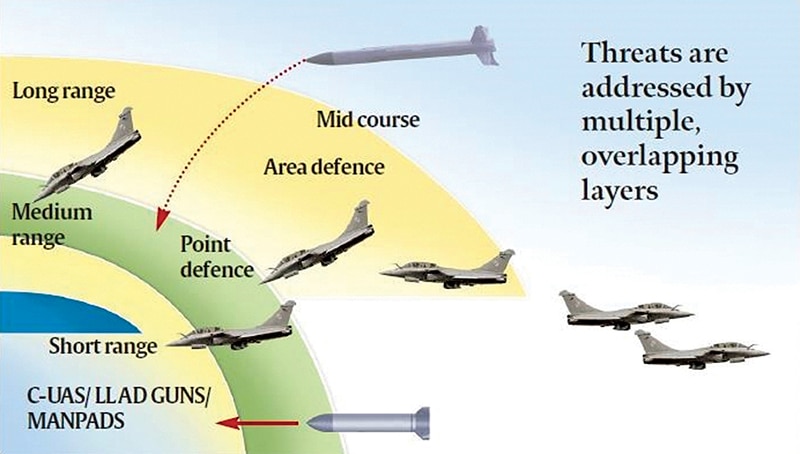
Mission Sudarshan Chakra envisions a nationwide, integrated shield capable of detecting, tracking, and neutralising threats across air, cyber, and electronic domains. Just as the mythological weapon combined speed, accuracy, and adaptability, the mission seeks to create a self-reliant, layered system-of-systems capable of responding swiftly and decisively to emerging challenges.
Designing the Sudarshan Chakra
The Sudarshan Chakra, conceived as a next-generation air and missile defence network, is structured as a modular and scalable framework. The architecture forms a multi-layered national grid that integrates detection, tracking, threat evaluation, and neutralisation across air, cyber, and electronic warfare domains.
The design ensures interoperability, integration of indigenous technology, and resilience in contested or degraded operational environments. The framework includes rapid counterattack capability against threats such as terrorist training camps, unmanned aerial systems (UAS), missile storage and launch sites, and command-and-control centres.
The design includes an AI-enabled processor capable of tracking and destroying multiple threats simultaneously. The framework is organised around three closely linked layers: the sensor layer, the command-and-control layer, and the interceptor layer.
Together, these layers sustain a continuous cycle of surveillance, AI-enabled decision-making processes, and engagement, enabling rapid response and operational effectiveness. Supporting the layers are auxiliary systems, including electronic warfare units, cyber defence mechanisms, satellite-based communication systems, and secure logistics and power infrastructure.
Supported by auxiliary systems, the structure enables seamless integration of future capabilities without compromising operational readiness.
Sensor layer
The sensor layer forms the surveillance backbone, integrating space-based, airborne, and ground-based sensors to provide continuous radar and data coverage across national airspace.
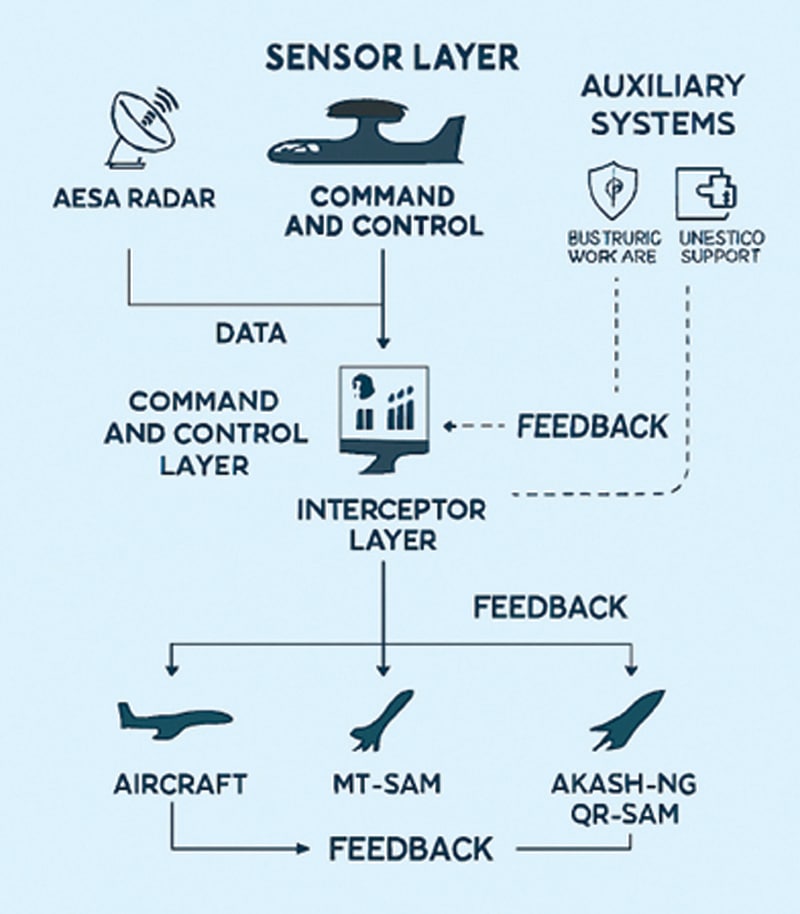
Operating in sync, long-range active electronically scanned array (AESA) radars (Box 1), airborne early-warning platforms, and surveillance satellites provide continuous target detection, early warning, and situational awareness even during electronic or cyber disruption.
Command-and-control layer
The command-and-control layer, anchored by the integrated air command and control system (IACCS), functions as the central nervous system. The layer fuses continuous streams of data from civil and military radars, satellites, and electronic intelligence sources. The fused raw data is transformed into a unified operational picture and instantly shared across the Army, Navy, and Air Force.
The AI system evaluates threat profiles by correlating sensor tracks, assessing intent, and prioritising risks. The validated threats are translated into engagement directives for the interceptor layer. Secure, encrypted communication networks protected against jamming and electronic warfare ensure uninterrupted command and control in hostile environments.
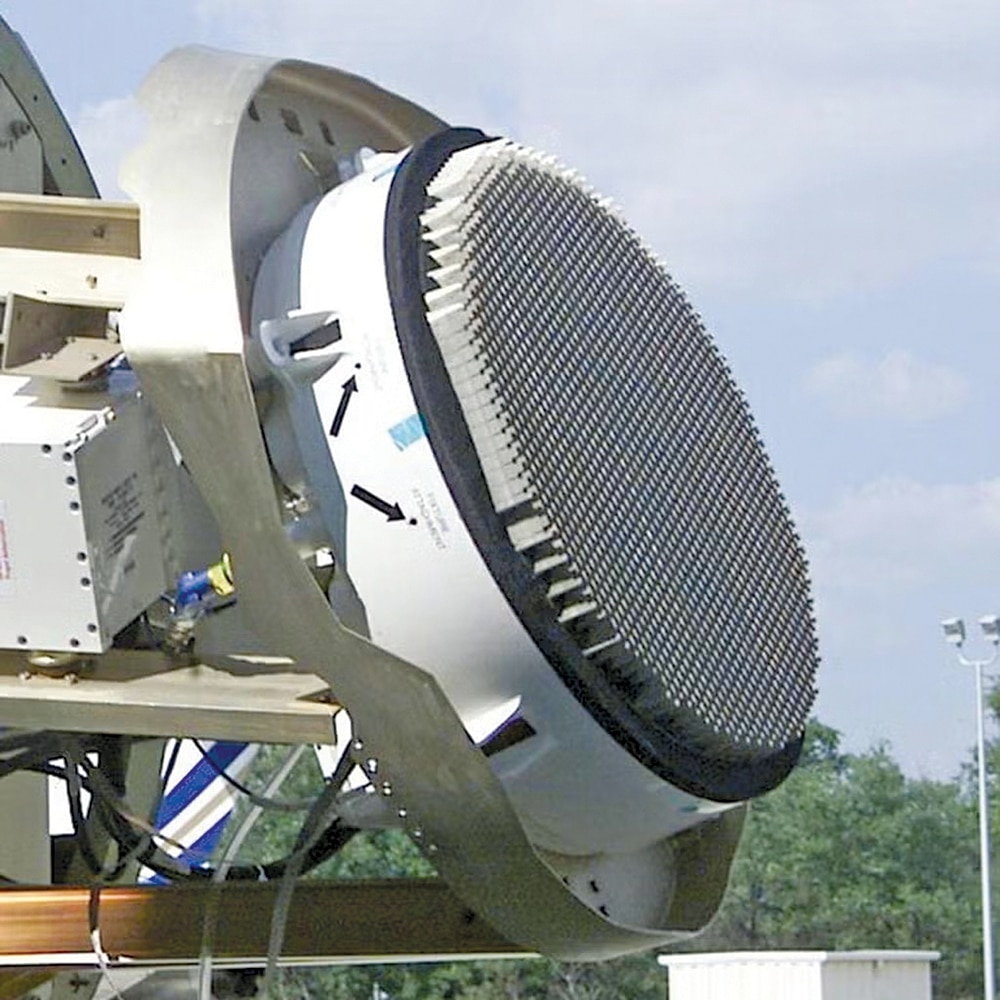
| Box 1: Active electronically scanned array (AESA) radars |
| AESA is an advanced radar technology built around thousands of miniature solid-state modules. AESA radar electronically steers beams, enabling simultaneous multi-target tracking and rapid transitions between surveillance and engagement. |
Interceptor layer
The interceptor layer is responsible for neutralising hostile targets using assets such as the integrated rocket force (IRF), precision-guided munitions, hypersonic missiles, and directed-energy weapons.
Once a threat is identified, the interceptor system (Box 2) engages the threat and provides a protective shield for the sensor and command-and-control layers, closing the operational loop. Operational feedback, including success rates, resource utilisation, and enemy response, is relayed to the command-and-control layer for real-time reassessment, rapid resource reallocation, and simultaneous counter-threat operations.
Mission Sudarshan Chakra: Implementation