Can an open source chip architecture really sit alongside Nvidia’s GPUs in the data centre? A $400-million funding round and a new hardware partnership suggest the answer might be yes.
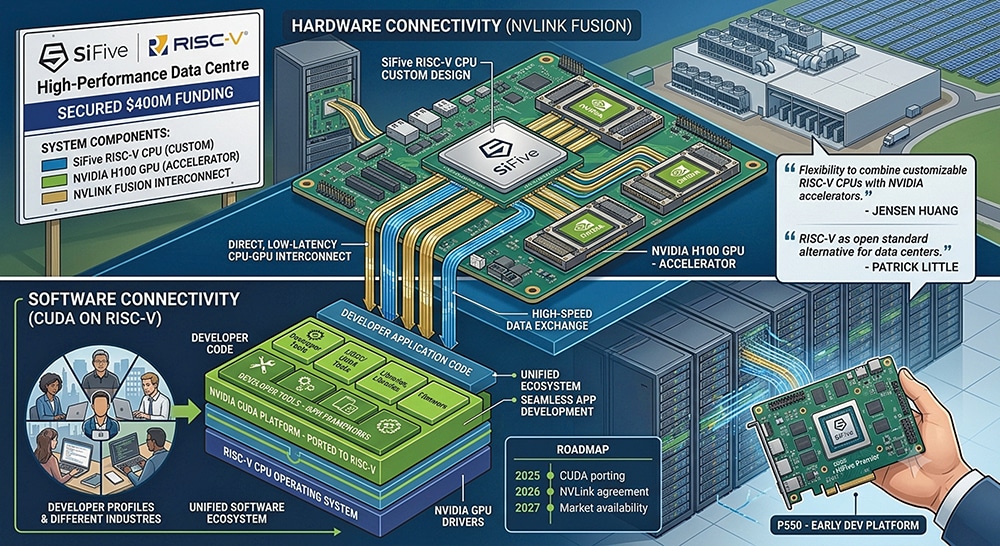
The reduced instruction set computing five (RISC-V) ecosystem just landed its biggest vote of confidence yet. SiFive has closed a $400-million Series G round, pushing its valuation to $3.65 billion.

What makes this round stand out isn’t just the size, but the investor list. Nvidia has joined as a backer, alongside Atreides Management, Apollo Global Management, Point72 Turion, T. Rowe Price Investment Management, Prosperity7 Ventures, and Sutter Hill Ventures. SiFive says the capital will go towards building high-performance RISC-V processors and artificial intelligence (AI) IP for data-centre use.
The investment is particularly interesting because it follows a technology partnership announced in January 2026, when SiFive said it would integrate Nvidia’s NVLink Fusion into its high-performance RISC-V data-centre designs. Nvidia is also working separately to bring its CUDA software stack to RISC-V.
What SiFive actually sells
SiFive doesn’t build finished chips. Instead, it licenses RISC-V-based processor IP that other companies customise and integrate into their own silicon. This allows customers to build processors for the specific performance, power, and workload requirements of their applications.

The company is now pushing this approach into higher-performance markets, including data centres. Its funding announcement points to growing interest from hyperscale customers that want greater control over how their processors are designed and optimised. Patrick Little, Chairman and CEO of SiFive, says, “Hyperscale customers have made it very clear that it is time to accelerate the availability of open standard alternatives for the data center.”
RISC-V sits at the core of this pitch. As an open instruction-set architecture—essentially the basic vocabulary a processor uses to execute operations—it gives chip designers a common foundation they can build on and extend with custom features, without being locked into a licensing model controlled by a single company.
Bridging RISC-V CPUs and Nvidia GPUs
An AI server does not rely on its graphics processing unit (GPU) alone. The central processing unit (CPU) still manages tasks and coordinates with the GPU, which handles the bulk of the AI workload. As models grow larger, the speed at which these processors can exchange data becomes increasingly important.
Nvidia’s NVLink Fusion is designed to help custom CPUs and accelerators communicate efficiently within high-performance computing systems. SiFive is working to bring this technology to its RISC-V-based solutions. Jensen Huang, founder and CEO of Nvidia, says, “This provides the flexibility to combine customisable RISC-V CPUs with Nvidia accelerators.”
For customers, this enables a customised RISC-V CPU to work alongside Nvidia GPUs as part of the same AI computing system. Instead of treating the CPU and GPU as completely separate components, the two could be designed to work more closely together.
However, this integration won’t happen immediately. Patrick told Reuters that its NVLink-enabled designs are not expected to reach the market before 2027.
Hardware is only half the story. Developers also need software that can actually put combined CPU-GPU systems to work. This is where Nvidia’s CUDA platform becomes important. In 2025, the company announced that it was porting CUDA to RISC-V, using SiFive’s HiFive Premier P550 as an early development platform.
CUDA provides the software tools and libraries developers use to build applications for Nvidia GPUs, so extending it to RISC-V could make it easier for developers to use a RISC-V CPU alongside an Nvidia GPU without having to build an entirely separate software environment.
As Patrick notes, “Without strong software support, the effort for companies to adopt new hardware technologies is simply too great.”
If this software support eventually matures into production-ready systems, the combination of RISC-V CPUs, Nvidia GPUs, NVLink, and CUDA could give data-centre operators a more customisable way to build AI computing systems.
But Nvidia already has its own CPU—so why RISC-V?
This raises an important question. If Nvidia already ships its own Arm-based data-centre CPU platform, why bother with RISC-V at all?
The answer lies in customisation. Nvidia’s Arm-based CPUs give data-centre customers a processor platform, while RISC-V could allow customers to develop CPUs more closely around their own requirements.
For hyperscalers running large data centres, this flexibility has real value. Instead of using the same general-purpose CPU design for every workload, a company could develop a processor with features suited to the way its systems operate.
This is where the SiFive-Nvidia collaboration becomes significant. A customer could potentially design a specialised RISC-V CPU, connect it to Nvidia GPUs through NVLink Fusion, and use Nvidia’s software ecosystem for AI workloads.
In this model, Nvidia would not have to provide every processor in the system. It can let customers own the CPU design while Nvidia continues supplying the GPUs, the interconnect, and the software that ties accelerated computing together. That also means this isn’t really RISC-V positioning itself as an Arm replacement. It’s more about giving data-centre customers an additional lever to customise the CPU side of systems built around Nvidia’s AI accelerators.
What comes next for Nvidia and SiFive?
The Nvidia-SiFive partnership is still at an early stage. NVLink-enabled designs are not expected to reach the market before 2027, and neither company has disclosed which processors or customers will be first in line.
Still, the direction is clear: RISC-V is pushing beyond the embedded and low-power markets where it’s traditionally been strong, and into high-performance computing territory. For Nvidia, backing RISC-V widens the pool of custom CPU designs compatible with its AI platform. For SiFive, access to Nvidia’s interconnect and software ecosystem opens a door into data-centre systems where performance, customisation, and AI acceleration increasingly go hand in hand.
The real question going forward isn’t whether RISC-V can compete with established CPU architectures anymore. It’s whether RISC-V can become the customisable CPU foundation for AI systems—while working alongside the GPUs and software platforms that already dominate accelerated computing
For Nvidia, supporting RISC-V would make its AI platform compatible with a wider range of customised CPU designs. For SiFive, access to Nvidia’s interconnect and software ecosystem opens a door into data-centre systems where performance, customisation, and AI acceleration increasingly go hand in hand.
The bigger question is no longer simply whether RISC-V can compete with established CPU architectures. It is whether it can become the customisable CPU foundation for AI systems, while working alongside the GPUs and software platforms that already dominate accelerated computing.
Saba Aafreen, Tech Journalist at EFY, blends on-ground industrial experience with a growing focus on AI-driven technologies in the evolving electronics industry.